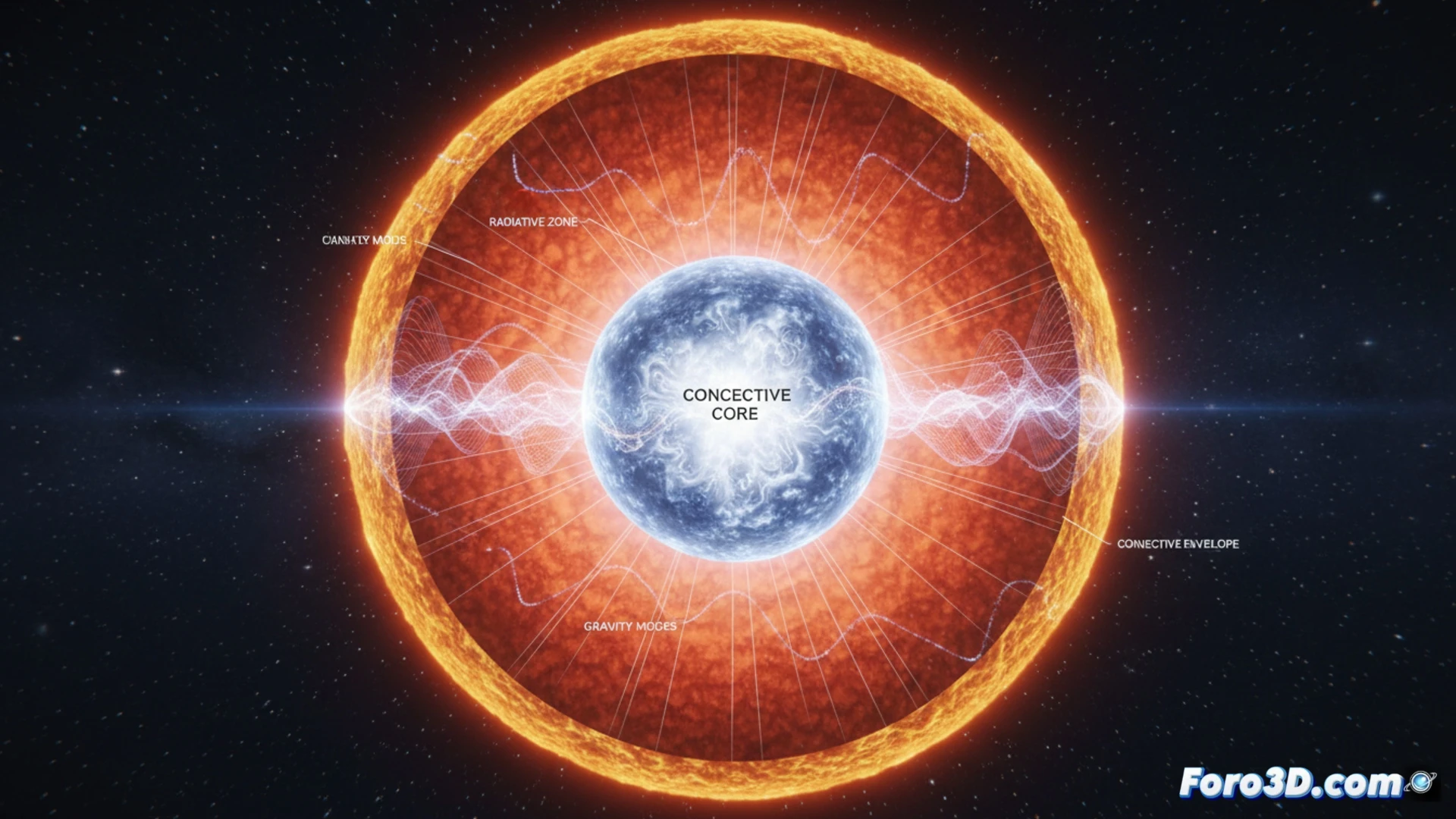
Asteroseismology advances with a new model that replicates the complete structure of pulsating F stars. For the first time, a simulation includes a convective core, radiative zone, and convective envelope, analyzing how these layers affect gravity modes, the oscillations that allow a glimpse into the stellar interior. The results indicate that the core defines the oscillation spectrum and that turbulence prevents the formation of some modes.
The core sets the rhythm of internal oscillations 🔭
The simulation reveals that the convective core decisively influences gravity modes, acting as a natural filter. The interaction with turbulence in the inner layers blocks certain modes, which fail to propagate. This limits the observable signals from space telescopes. Detecting these oscillations remains a technical challenge, as it requires highly sensitive instruments capable of capturing minimal variations in stellar brightness, a slow and costly endeavor.
Stars also have their moving days 🌟
It turns out that F stars not only shine but also create an internal seismic commotion. The core, like a noisy neighbor, decides which gravity modes can reach the surface and which remain trapped. Turbulence, for its part, acts like a nightclub bouncer that prevents certain waves from passing through. So, while astronomers try to listen to the stellar interior, the stars do whatever they want. A matter of character.