In the upper atmosphere, far above the roar of storms, an electrical phenomenon of colossal scale occurs: Red Sprites or Sprites. These massive discharges, with their jellyfish or carrot-like shapes, illuminate the mesosphere and were a mystery until their photographic confirmation in the late 20th century. Within the niche of Scientific Visualization, representing this event in 3D allows for unveiling its true magnitude, location, and dynamics, transforming atmospheric data into an educational and awe-inspiring visual experience.
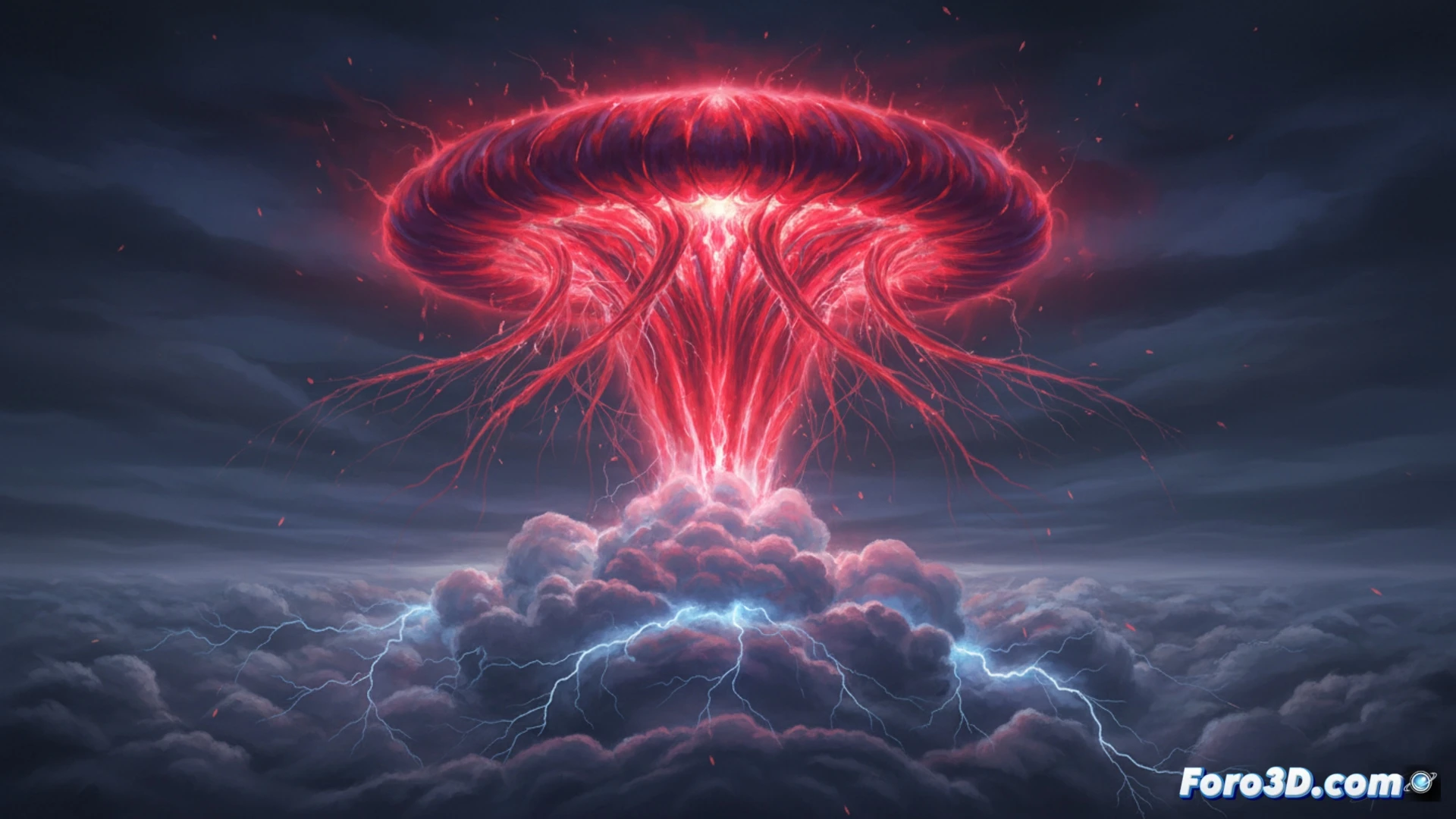
3D Modeling of a Large-Scale Phenomenon ⚡
An effective visualization must address several technical aspects. First, scale: a stratified 3D model of the atmosphere can accurately place sprites between 50 and 90 km in altitude, contrasting them with the thunderstorm cloud layer (at 10-15 km) and the silhouette of a commercial airplane. Second, shape: their characteristic structure, with a main body and numerous descending filamentary tentacles, can be digitally sculpted. Third, simulation: applying particle shaders and lighting effects allows for recreating the intense red emission and the fleeting electrical nature of the phenomenon, completing a comprehensive visual explanation.
From Myth to Data: The Visual Timeline 📅
The scientific confirmation in 1989 is a key point. An interactive 3D timeline can show decades of anecdotal reports converging on that first captured frame. This visual narrative not only educates but emphasizes how technology expands our perception. In the end, the visualization not only illustrates a sprite but makes tangible a chapter of scientific discovery, inviting reflection on the hidden phenomena still waiting to be revealed.
How can scientific visualization techniques be used to model and represent the complex fractal structure and dynamics of Sprites in the mesosphere?
(PS: at Foro3D we know that even manta rays have better social connections than our polygons)