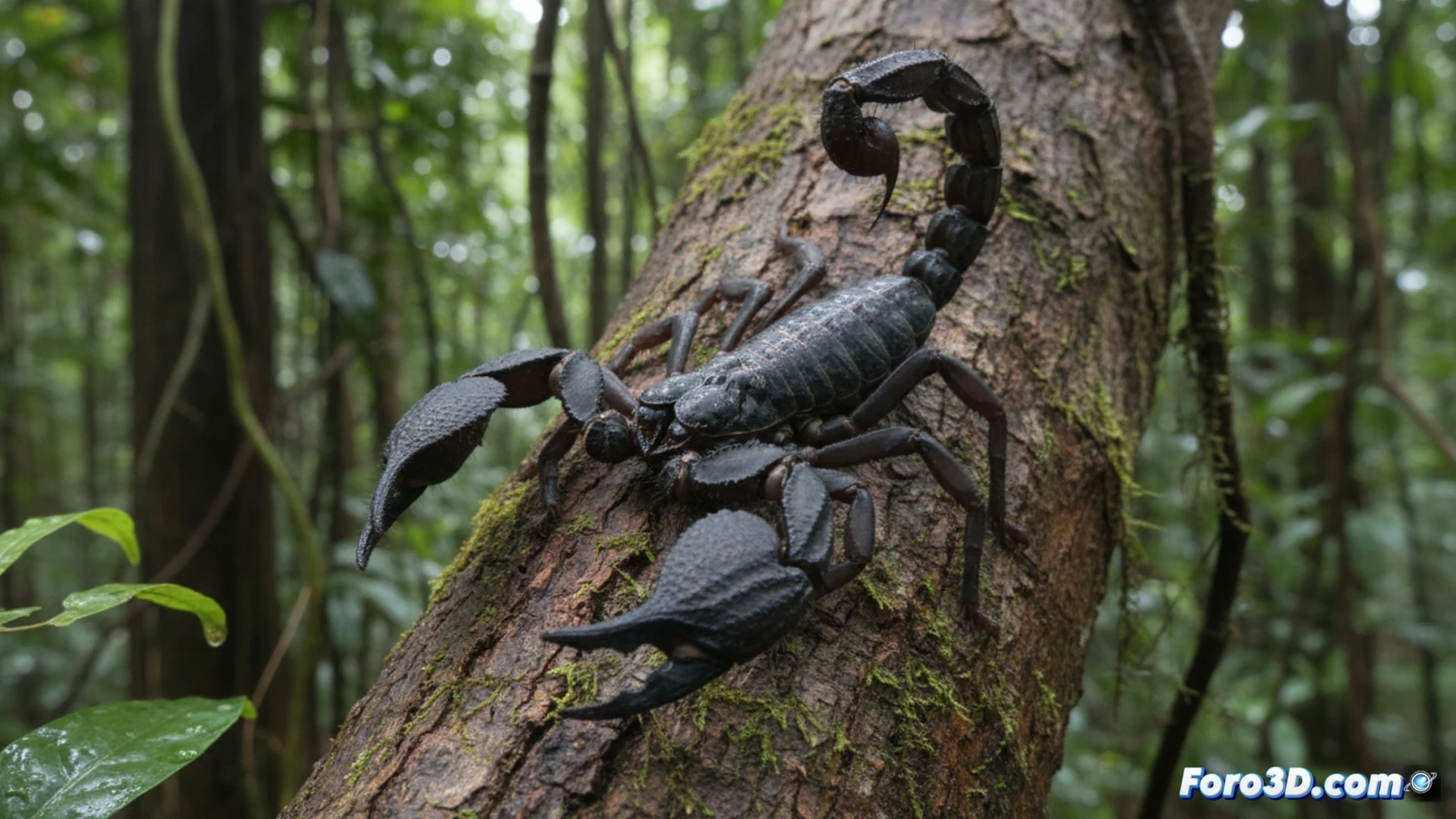
The discovery of a new species of arachnid in the virgin jungles of Southeast Asia has shaken the scientific community. Dubbed the giant bark scorpion, this nocturnal predator features a cryptic exoskeleton and a potent venom. For scientific visualization specialists, this finding represents a fascinating technical challenge: digitally recreating a creature of which barely any living specimens exist, using field data to generate an accurate digital twin.
Photogrammetry and 3D scanning for specimen documentation 🦂
The digitization process for this new species relies on non-invasive techniques. Using high-resolution photogrammetry, hundreds of images of the specimen are captured from controlled angles. Reconstruction software processes these shots to generate a detailed polygonal mesh, which is then textured with reflectance maps. The result is a photorealistic 3D model that allows observation of the morphology of the chelicerae, telson, and venom glands with a level of detail impossible to achieve with traditional methods. This model serves as a basis for biomechanical animations that simulate its hunting patterns.
Habitat simulation and educational outreach 🌿
Beyond anatomy, scientific visualization allows for the reconstruction of the scorpion's ecosystem. By integrating canopy lighting and humidity data, a virtual jungle environment is generated where the 3D model behaves according to real ethological patterns. This simulation, compared with known species such as the emperor scorpion, facilitates outreach in museums and educational platforms. The 3D community has here a unique opportunity to collaborate with biologists, creating digital assets that preserve knowledge of a newly discovered species without disturbing its fragile habitat.
What was the greatest technical challenge in modeling the bioluminescent scales of this new species of giant bark scorpion for accurate scientific 3D visualization?
(PS: at Foro3D we know that even manta rays have better social connections than our polygons)