Coin authentication has entered a new era with the application of confocal 3D scanning. A recent case demonstrates how this technology allows experts to detect high-quality counterfeits by analyzing the surface of the suspect coin. The key finding lies in the electroerosion patterns, direct evidence that the counterfeit die was made from a real coin, not an original design.
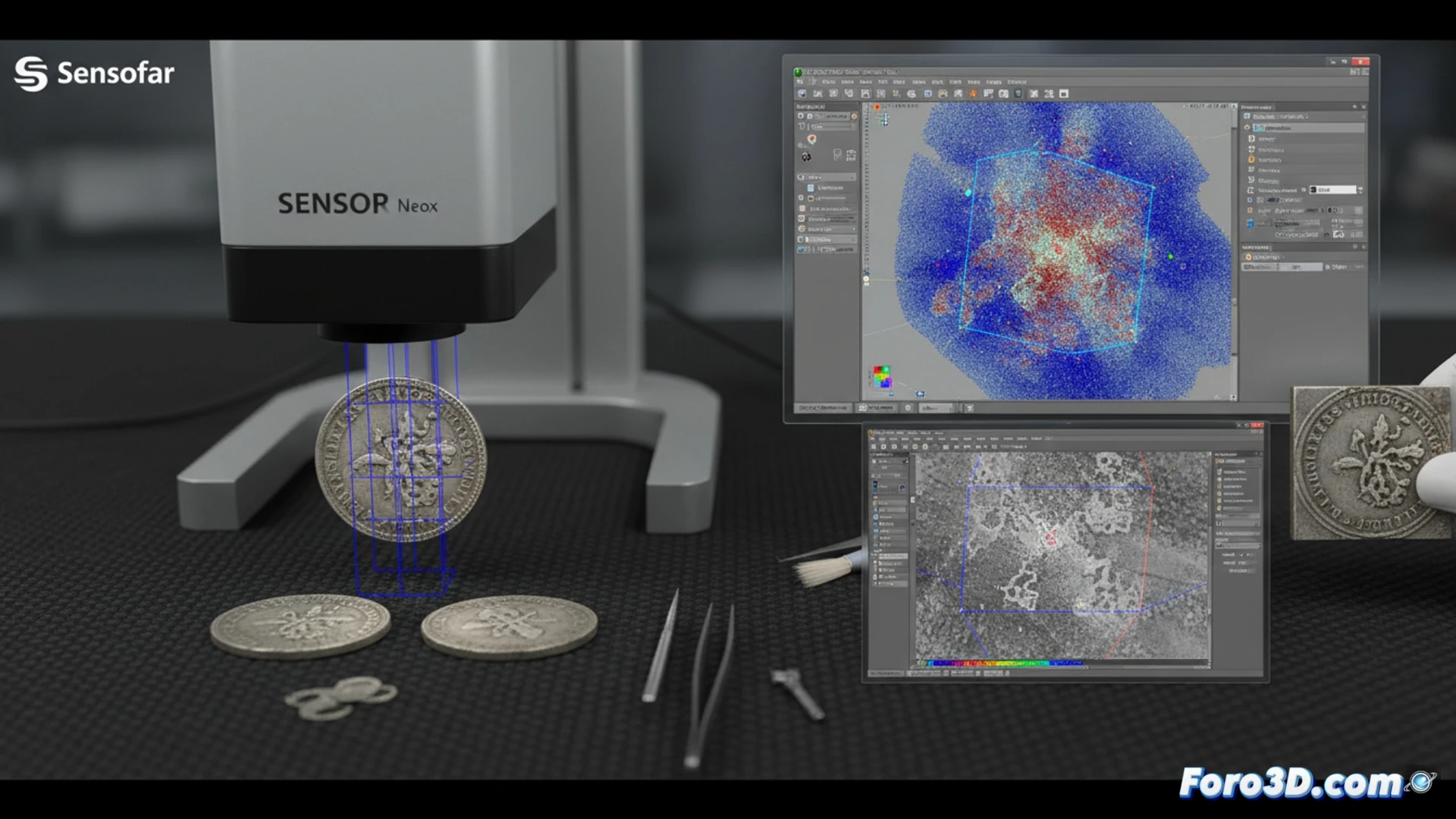
Forensic Pipeline: From Confocal Scanning to Evidence Map 🔬
The forensic workflow begins with confocal 3D scanning of the suspect coin using an optical profilometer such as the Sensofar S neox. This equipment captures surface topography with nanometric resolution, generating a high-density point cloud. The raw data is processed in Gwyddion, a surface analysis software. Here, the expert applies filters to remove the general curvature of the coin and enhances micrometric details. The analysis reveals linear and parallel micro-striations, characteristic of penetration electroerosion (EDM). These marks are the signature of the die manufacturing process: an electrode copies the shape of an authentic coin and erodes the die steel. Finally, 3D color and height maps are exported and, refined in Photoshop, serve as irrefutable visual evidence in an expert report.
Expert Implications: The Technical Proof of the Inherited Die ⚖️
This approach transforms forensic numismatics by providing objective technical proof. The presence of electroerosion patterns not only confirms the forgery but directly links the counterfeit die to a specific original coin. The expert no longer relies solely on differences in weight or alloy; they can now demonstrate, with a 3D map, that the minting tool was cloned. This evidence is robust in a court of law, as the process is reproducible and the data is quantifiable, raising the verification standard in the fight against numismatic counterfeiting.
What limitations does confocal 3D scanning present when detecting wear micromarks or surface corrosion on ancient coins that have been in circulation?
(PS: In the forensic pipeline, the most important thing is not to mix the evidence with the reference models... or you'll end up with a ghost at the scene.)