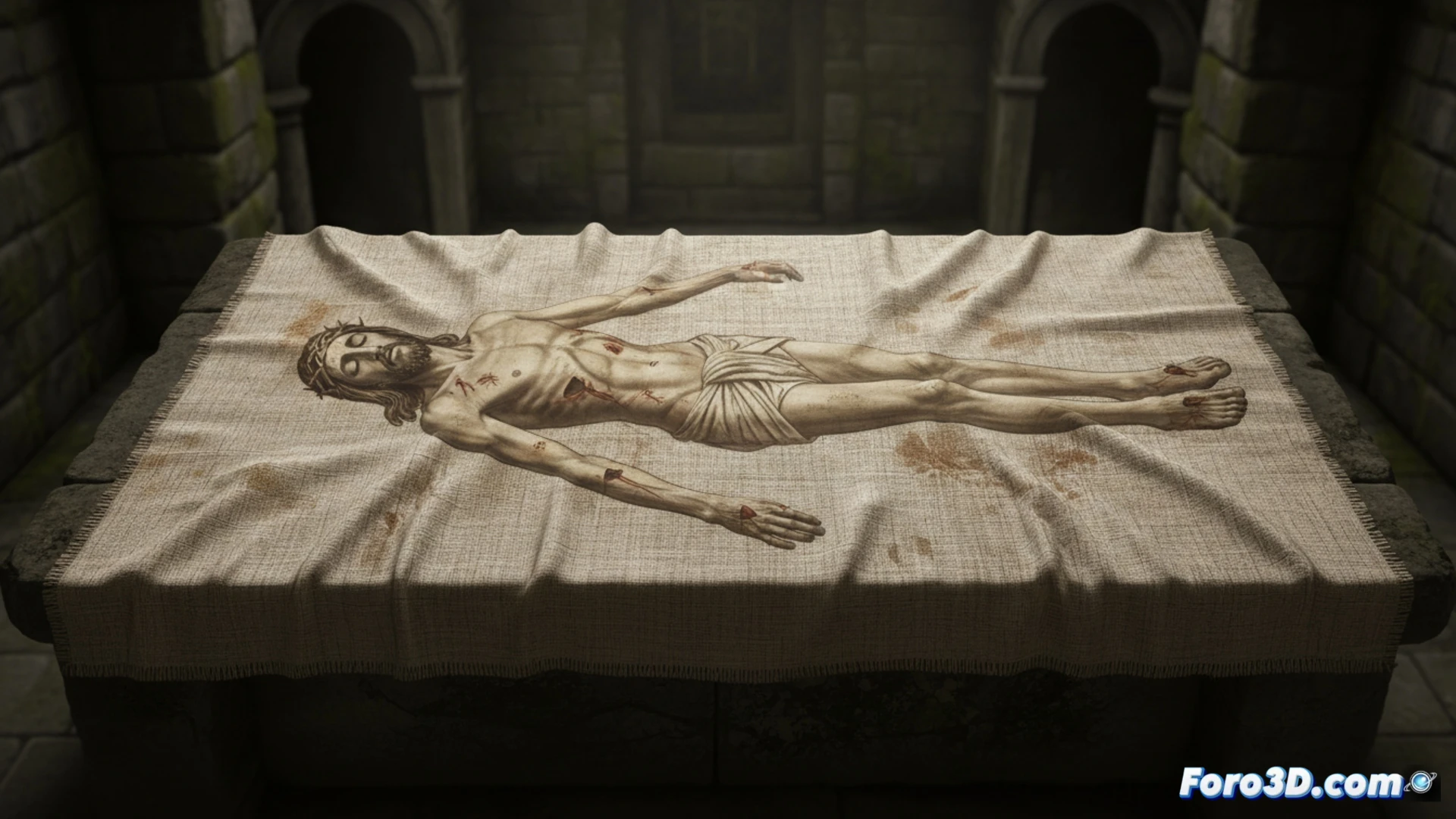
The Shroud of Turin, one of the most enigmatic and debated relics, presents a negative image of a man with crucifixion marks. Its origin, whether medieval or ancient, and the process of image formation remain a scientific mystery. In this context, digital archaeology emerges as a fundamental tool, offering non-invasive methods to scrutinize the linen and provide objective data to a debate historically laden with subjectivity.
Photogrammetry and laser scanning: a digital autopsy 🔍
Techniques such as high-resolution photogrammetry and 3D laser scanning allow for the creation of an exact digital model of the cloth, capturing the microscopic topography of the fibers and the spatial distribution of stains. This volumetric model makes it possible to analyze the relationship between the fabric and the image independently of color, studying possible deformations caused by an underlying body. Furthermore, multispectral texture mapping can quantify the oxidation and dehydration of the fibers, looking for patterns consistent with a process of energy transfer or contact, providing physical evidence to the debate about its formation.
Beyond authenticity: preserving the debate 💾
The true value of 3D documentation goes beyond determining authenticity. It creates a perpetual and unalterable digital archive of the relic's current state, crucial for its conservation. Additionally, it democratizes access to study, allowing researchers worldwide to analyze the same objective model, fostering a scientific debate based on replicable data and far removed from speculation.
How can 3D scanning and modeling provide new evidence about the formation of the image on the Shroud of Turin?
(PS: If you dig at an archaeological site and find a USB stick, don't plug it in: it could be Roman malware.)