A recent report by the AMGTA uncovers a recurring error in the industry: evaluating additive manufacturing by comparing only the cost per part. This approach ignores the systemic advantages of the technology, such as material efficiency, inventory reduction, and more agile capital allocation. The result is a systematic underestimation of its real value.
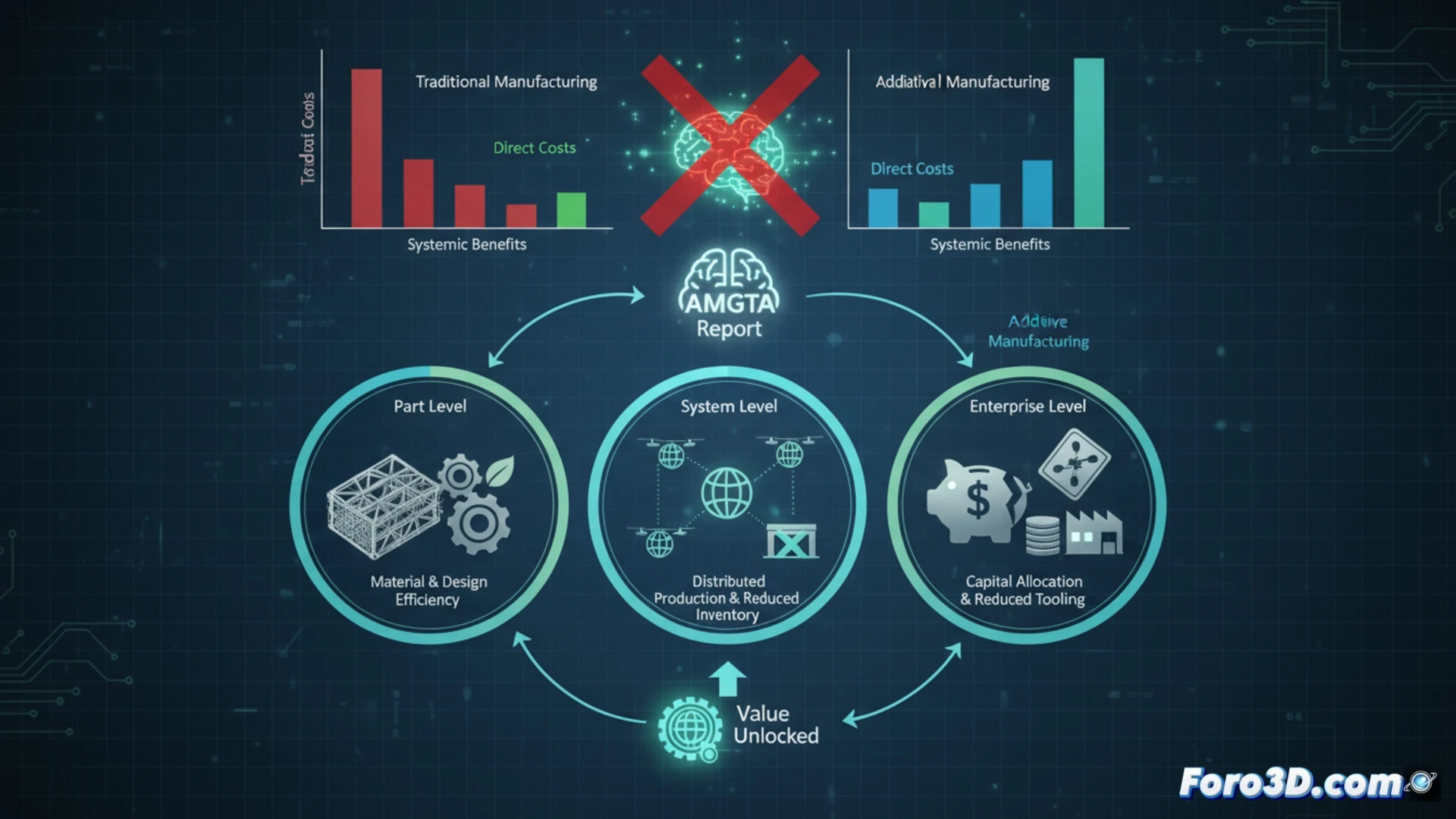
Three Levels of Structural Advantage in Additive Manufacturing 🔍
The AMGTA analysis breaks down the impact into three layers. At the part level, 3D printing allows for near-total material use and designs impossible to mill. At the system level, distributed production eliminates warehouses and shortens supply chains. At the business level, it reduces dependence on molds and minimum order quantities, freeing up capital that was previously trapped in tooling and stock.
The Drama of Comparing Apples to Oranges (and Paying for It) ⚖️
The problem is that we are still using a 20th-century calculator to measure a 21st-century technology. Comparing the unit cost of a printed part with an injected one is like saying a drone is worse than a truck because it only carries one package. Of course, if you ignore that the drone doesn't need tolls, a driver, or a warehouse. Next time, look at the total system cost, not just the filament cost.