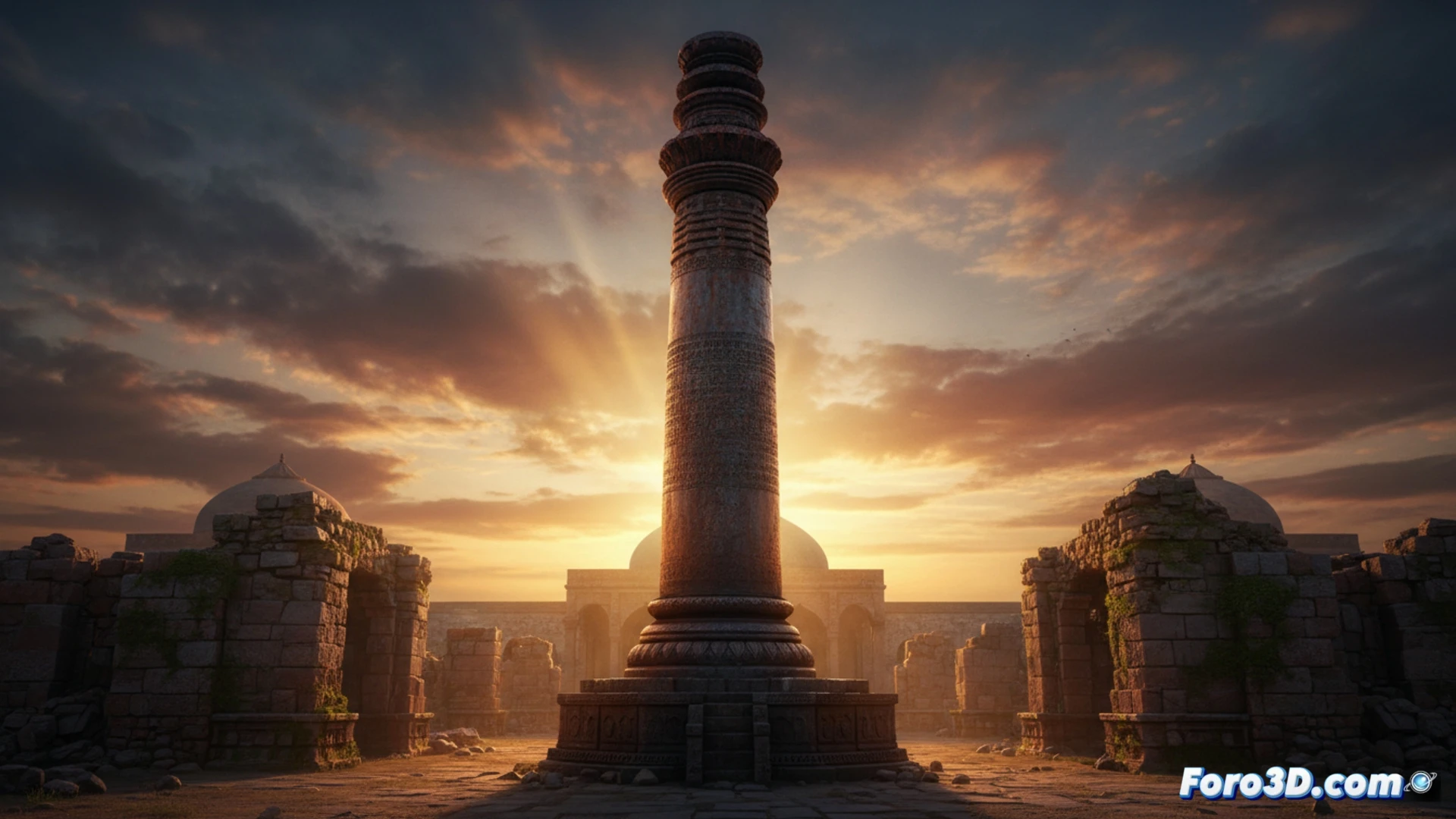
In the Qutb complex in Delhi stands a 4th-century AD wrought iron column that defies the passage of time. With over 1,600 years behind it, it shows exceptional resistance to atmospheric corrosion. This artifact, known as the Iron Pillar, is not just a monument, but a perfect case study for Digital Archaeology, where 3D documentation techniques can unveil the secrets of its longevity and preservation.
3D Documentation and Non-Invasive Analysis of the Protective Layer 🔍
Digital Archaeology finds in this pillar an ideal subject. Through high-resolution photogrammetry or terrestrial laser scanning, a millimeter-accurate 3D model can be generated. This model allows for exact geometric analysis, monitoring of its conservation status, and detailed study of the famous passivating rust layer that protects it. Furthermore, specialized software could simulate corrosion processes over centuries, contrasting the data with observable reality and helping to validate hypotheses about its advanced metallurgical composition rich in phosphorus.
Preserving the Legacy by Materializing the Digital 💾
Beyond study, the 3D model becomes a fundamental tool for dissemination and digital preservation. It allows for the creation of exact archives for future generations, facilitates virtual visits, and enables the production of physical replicas via 3D printing for museums. Thus, technology allows us to unravel the mysteries of an ancient technical feat without touching the monument, honoring the principle of non-invasiveness and democratizing access to a unique heritage.
How can digital archaeology, through techniques such as 3D modeling, elemental composition analysis, and corrosion simulation, help unveil the mystery of the rust resistance of the Delhi Iron Pillar?
(PS: If you're excavating a site and find a USB, don't plug it in: it could be malware from the Romans.)