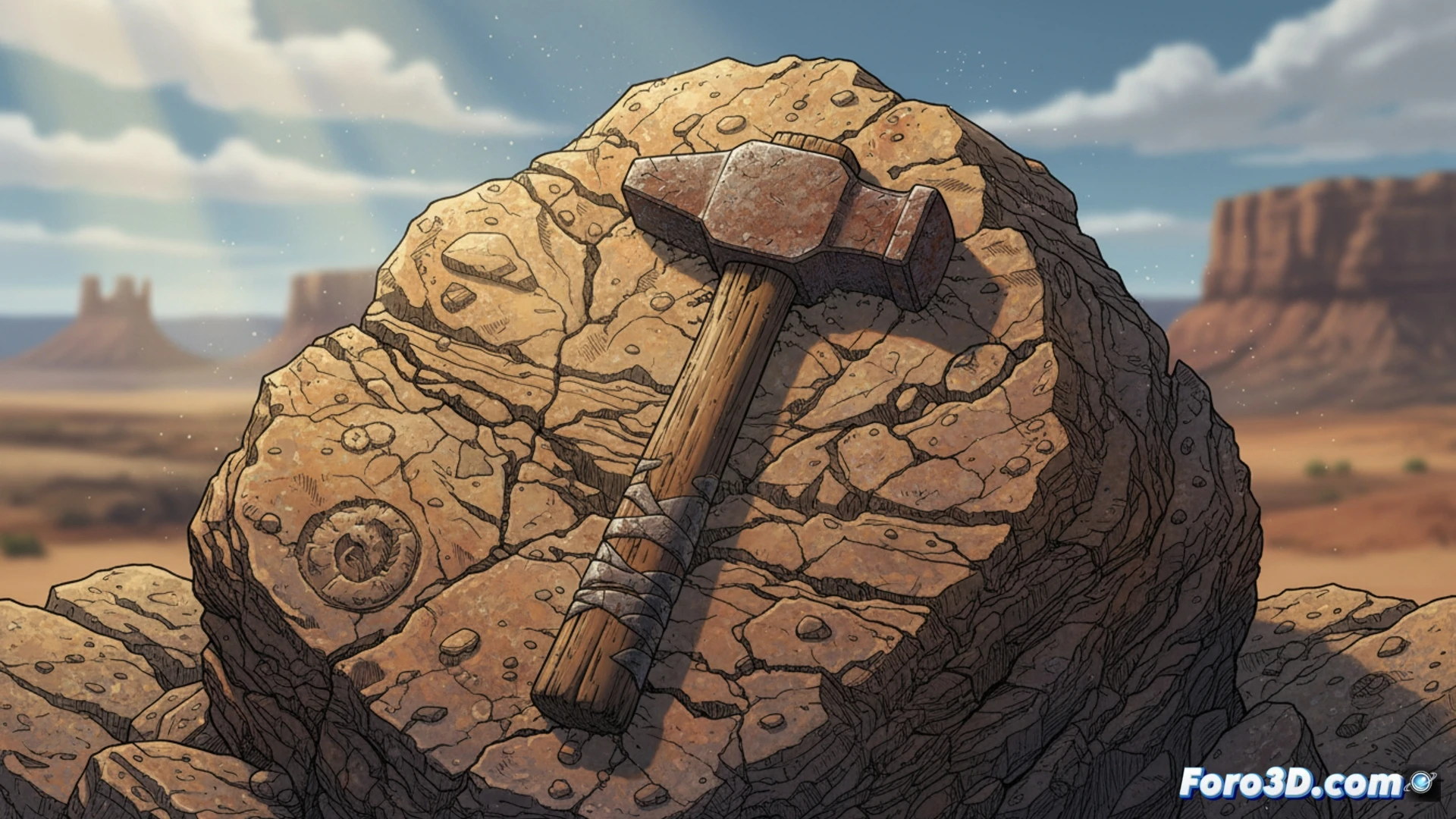
The so-called London Hammer, found in Texas embedded in rock, is an enigma that has fueled debates since its discovery. A 19th-century artifact trapped in ancient stone? These types of seemingly anachronistic findings underscore the need for rigorous and non-destructive analysis. This is where 3D technology becomes the ultimate archaeological tool, allowing for objective and perpetual documentation of the object in its exact context.
Photogrammetry and Laser Scanning: Unraveling the Mystery Layer by Layer 🔍
For an artifact like this, the first step would be to create a high-precision 3D model. Through photogrammetry, hundreds of photographs of the hammer and the rock from all angles would allow for the reconstruction of its geometry and surface texture with millimeter fidelity. A laser scanner would complement this data, capturing the exact shape of the cavity and the insertion point. This digital model would allow for the analysis of the hammer-rock interface, the search for microfractures or sedimentation, and the measurement of wear without touching the original, providing scientific data to contrast theories about its formation.
Digital Preservation and Outreach Beyond the Myth 💾
Beyond analysis, the 3D model becomes a permanent asset. It serves as a conservation archive, monitoring any future changes. Furthermore, it democratizes access: any researcher can study the object virtually, and physical replicas can be generated for museums. 3D technology does not solve the mystery by itself, but it transforms speculation into a debate based on tangible and accessible data, preserving the find for future research.
How can 3D printing and digital scanning help unravel the mystery of the provenance and dating of out-of-place artifacts like the London Hammer?
(PS: If you're digging at a site and find a USB drive, don't plug it in: it could be malware from the Romans.)