An army of 5,000 robots has managed to map the cosmos like never before. This robotic telescope, designed to unravel the mystery of dark energy, has generated the largest and most precise three-dimensional map of the universe. Each robot adjusts thousands of optical fibers to capture light from distant galaxies, measuring their redshift and calculating cosmic distances with unprecedented accuracy.
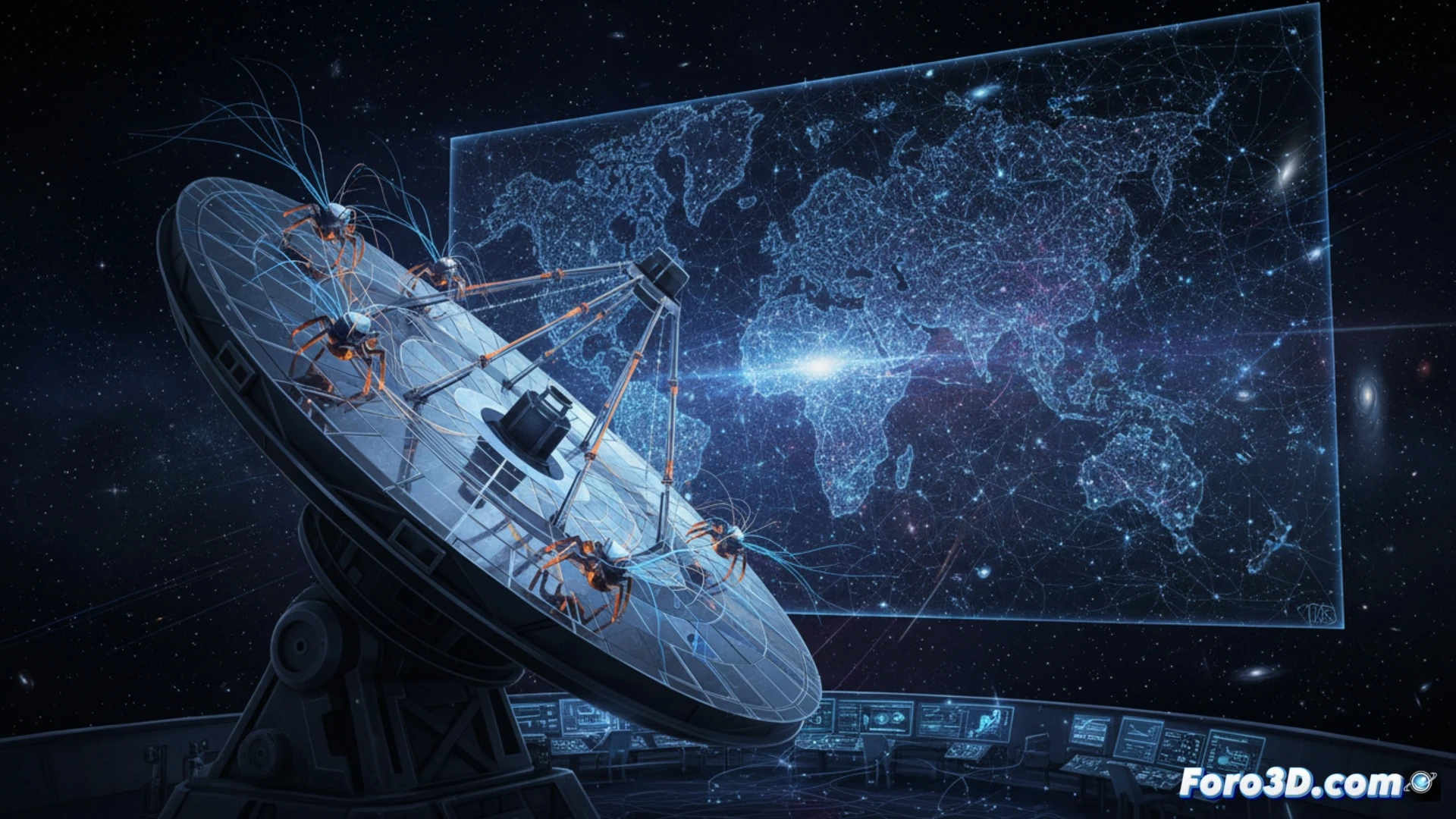
Scientific visualization of cosmological data: from redshift to 3D structure 🌌
The technical key to this advancement lies in the ability to convert spectral data into volumetric representations. The robots position optical fibers on focal plates to collect light from millions of galaxies. By measuring the redshift, scientists obtain the third dimension: depth. The result is a massive point map where each point represents a galaxy. To visualize this dataset, volumetric rendering techniques and clustering algorithms that reveal cosmic filaments and voids are employed. These 3D representations allow observation of how dark energy has shaped the galaxy network over 11 billion years, offering a visual laboratory to test cosmological models.
The challenge of making the invisible visible: communicating dark energy in 3D 🔭
Dark energy is an invisible force that accelerates the expansion of the universe, but its effect is only perceived in the geometry of space-time. The 3D map acts as a visual translator: by showing how galaxies cluster, scientists can infer the influence of this energy. For outreach, interactive infographics and animations that traverse the map allow the public to navigate the cosmic structure. This approach transforms abstract data into an immersive experience, bringing the greatest enigma of modern physics closer to anyone interested in the destiny of the cosmos.
What specific technical challenges of rendering and real-time data management arise when visualizing a 3D map of the universe generated by 5000 robots, and how is the representation of large-scale structures like galaxy filaments and cosmic voids optimized for scientific analysis?
(PS: fluid physics for simulating the ocean is like the sea: unpredictable and you always run out of RAM)