The Voynich Manuscript, a 15th-century codex written in a completely unknown language and writing system, has challenged cryptographers and historians for centuries. Its pages, filled with illustrations of fantastic plants and non-existent celestial maps, represent one of the greatest archaeological mysteries. Today, digital archaeology offers new tools for its study, applying non-invasive 3D documentation techniques that promise to preserve its integrity and, perhaps, unveil its hidden secrets.
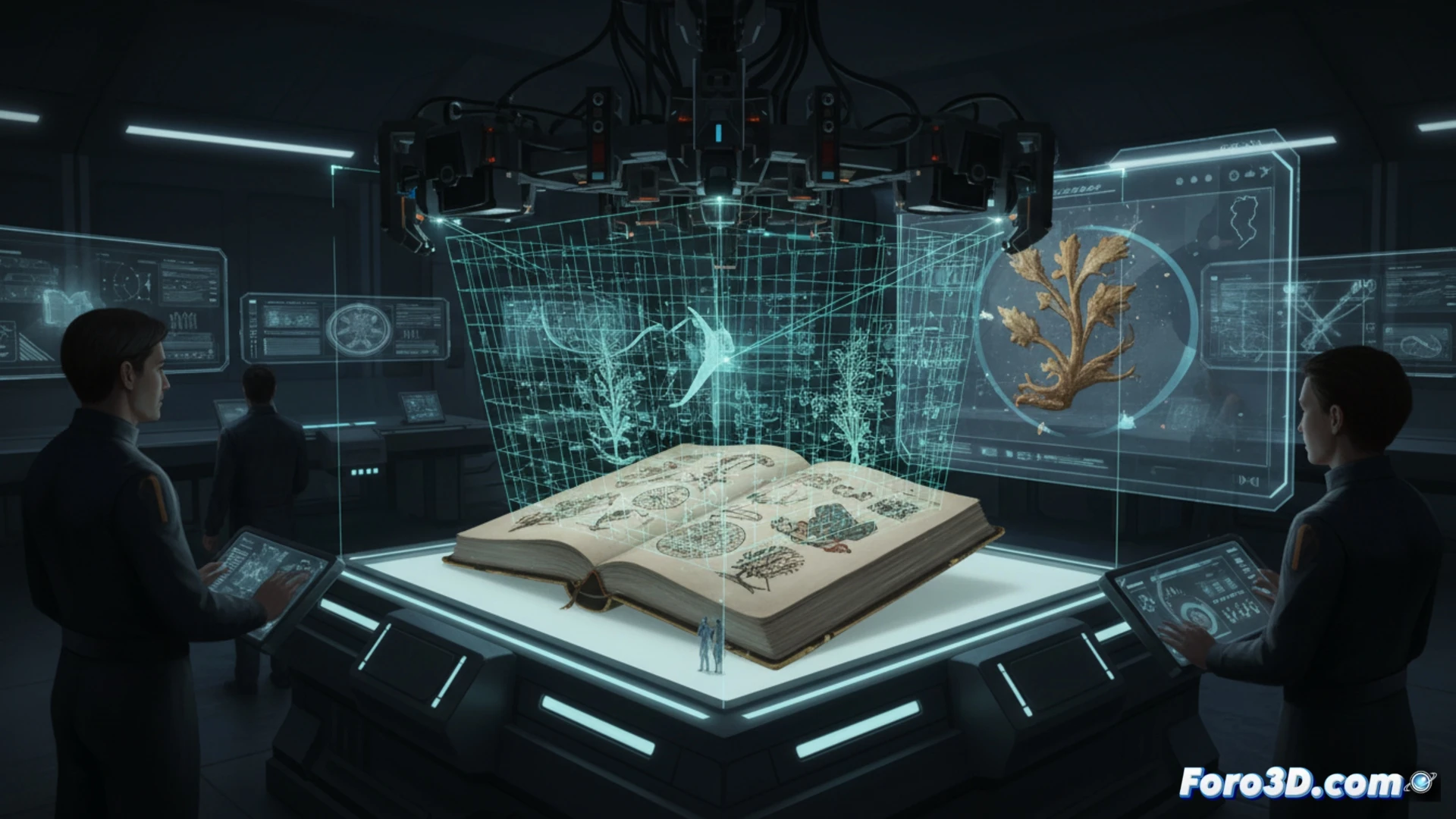
Photogrammetry and Spectral Scanning: The Researcher's New Magnifying Glass 🔍
The application of high-resolution photogrammetry and 3D scanning allows for the creation of exact digital replicas of each folio, capturing the microscopic topography of the surface, the deformations of the parchment, and the texture of the brushstrokes. Beyond geometry, multispectral imaging techniques illuminate the manuscript with wavelengths invisible to the human eye. This process can differentiate chemical compositions in the inks, reveal erased or corrected strokes, and bring forth watermarks or faded details in the illustrations, providing an objective dataset for paleographic and material analysis without physical contact.
Digital Preservation and Global Access to the Mystery 🌐
3D digitization transcends mere conservation; it democratizes access. Researchers from all over the world can examine the virtual model, rotate it, and study it under virtual lighting from any angle, reducing the handling of the fragile original. This accessibility fosters multidisciplinary collaboration, inviting botanists, astronomers, and linguists to explore the same immersive artifact. Thus, technology not only protects the codex but transforms a mystery kept in a vault into an open challenge for the global scientific community.
How can 3D modeling and analysis techniques reveal the internal structure and hidden layers of the Voynich Manuscript's parchment to provide new clues about its authorship and content?
(PS: and remember: if you can't find a bone, you can always model it yourself)