A recent study analyzes how the spin parameter of dark matter halos evolves in the Lambda-CDM model. Far from being constant, its average value changes smoothly and linearly with redshift. This allows for more precise adjustments to galaxy formation models, although it adds complexity to the process.
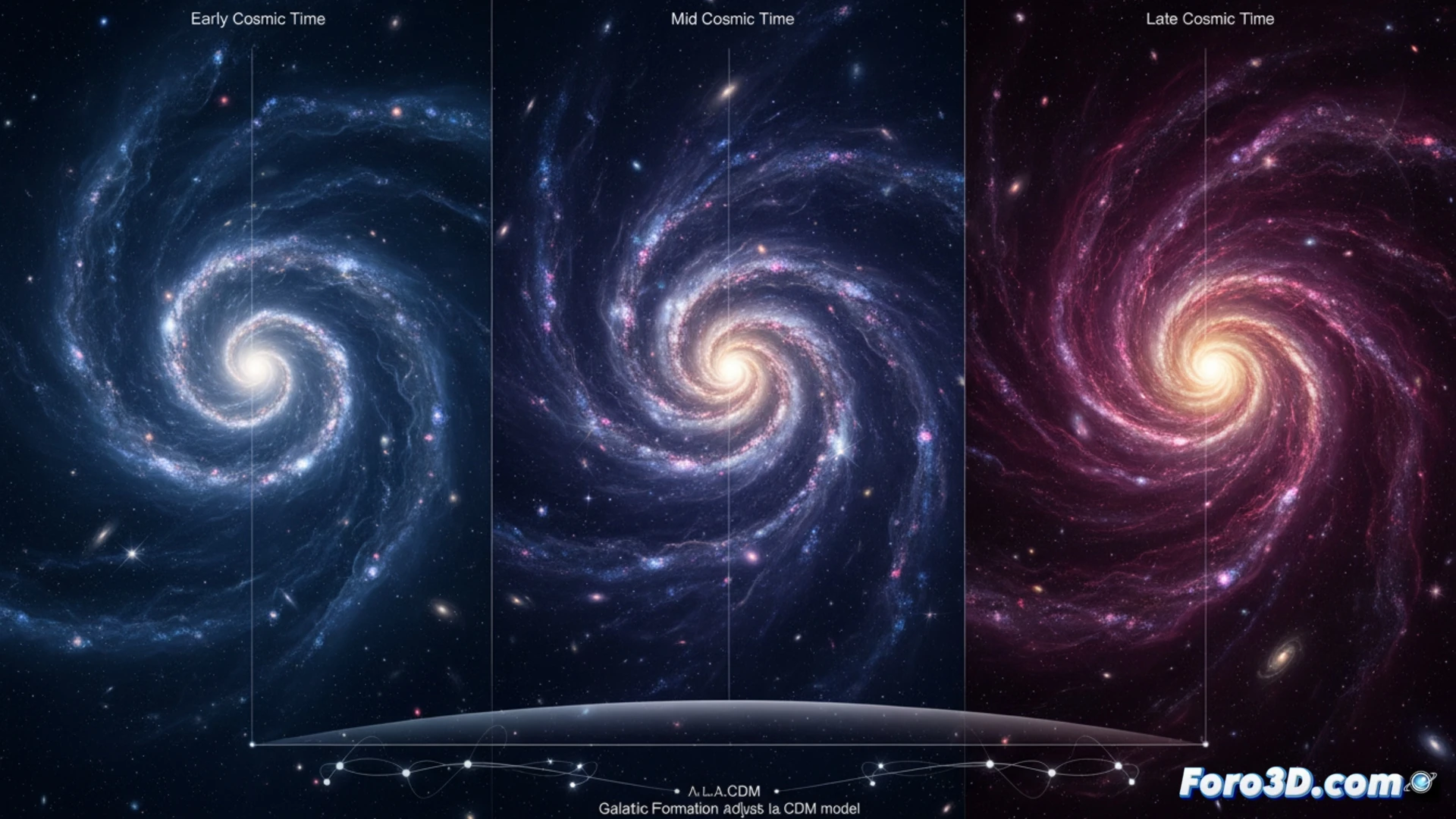
New analytical formulas to simulate the evolution of spin 🌌
The research authors used numerical simulations to track spin (ln λ) and its variant (ln λ′). While the former shows a linear evolution, the latter exhibits a non-monotonic behavior with an inflection point around z≈1-2. Analytical expressions are provided that allow estimating these values at different times in the universe, offering more realistic tools for modeling galaxy formation without relying on constant assumptions.
Dark matter spin, more fickle than a teenager 😅
It turns out that dark matter also has its existential crises. Just when we thought its spin was stable and predictable, it turns out to change its mind around z≈1-2. It's as if the universe, bored with so much constancy, decided to add a little dramatic twist to the plot. Good thing researchers already have formulas to keep up with this cosmic dance.