A private collector discovered that their valuable pre-Columbian gold statue had been replaced by an almost perfect replica. The scam was only uncovered when the piece was subjected to high-resolution 3D scanning. Beneath the gold coating, the analysis revealed a pattern of microscopic layers typical of stereolithography (SLA) printing, a trace invisible to the human eye but evident to digital metrology.
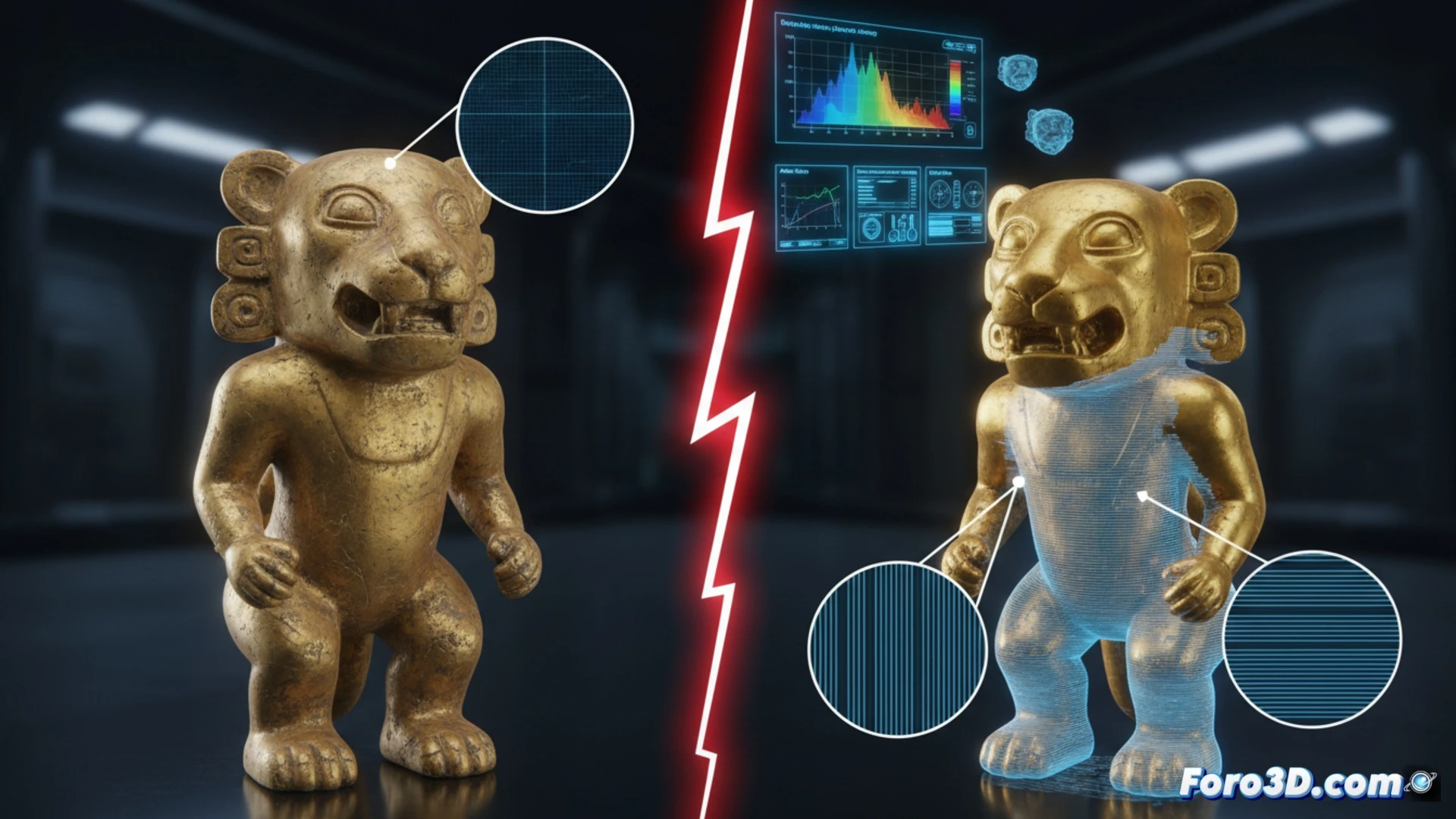
Forensic 3D analysis: from Artec Micro to MountainsMap 🔍
The authentication process began with the Artec Micro scanner, capable of capturing geometries with micrometric precision. The data obtained was processed in GOM Inspect to align the point cloud with a reference model of the original piece. However, the definitive test came with MountainsMap, a surface micro-texture analysis software. This revealed a periodic and uniform roughness pattern, characteristic of layers of resin cured by SLA. In an authentic hammered gold piece, the roughness is random and organic; here, the mathematical repetition of the lines betrayed the 3D printing.
Legal implications for digital heritage ⚖️
This case sets a precedent in the protection of intellectual property for historical assets. For collectors and auction houses, digital certification is no longer a luxury, but a necessity. Forensic 3D expertise, combining high-precision scanning and micro-texture analysis, positions itself as the ultimate tool against fraud. Without this technological shield, any relic can be cloned and sold as authentic, challenging copyright and the integrity of cultural heritage.
What legal and evidentiary challenges does a collector face when proving the authenticity of a pre-Columbian artwork through 3D scanning under intellectual property and digital law legislation?
(PS: AI can generate art, but not copyright... like us, who generate polygons but not money)