The Domostroy, an anonymous 16th-century Russian manual, is much more than a list of household rules. It is a textual time capsule that meticulously details daily life, from family hierarchy to the care of household goods. For digital archaeology, this text becomes an invaluable primary source, a precise guide for reconstructing in three dimensions the material and social world of medieval Russia, transforming written precepts into tangible spaces and objects.
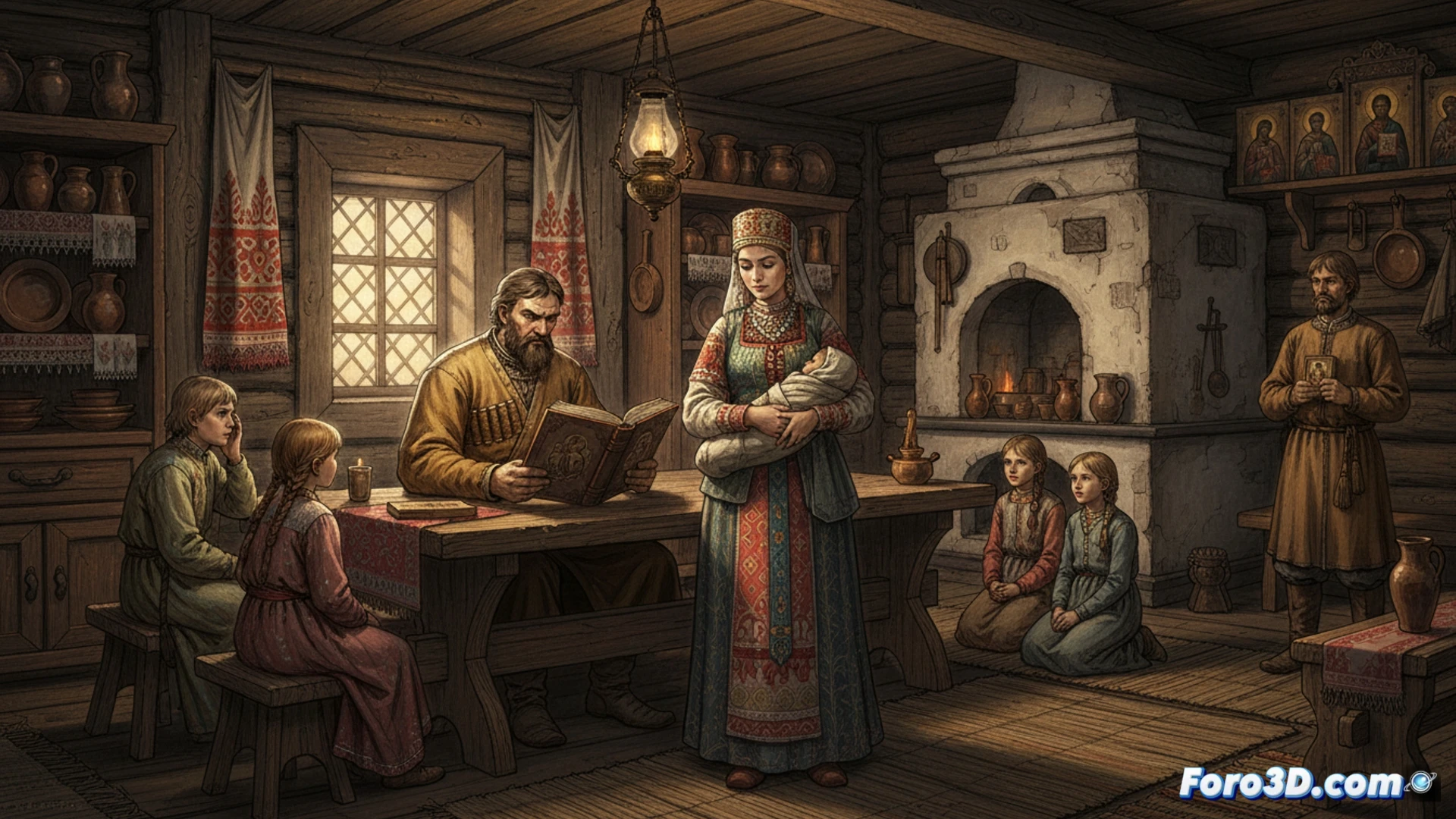
From Rule to 3D Model: A Reconstruction Project 🏠
A digital archaeology project based on the Domostroy would have as its core the faithful recreation of an izba, the typical dwelling. The instructions on the distribution of spaces, the placement of the icon in the beautiful corner, the structure of the stove, and the fixed benches offer a direct architectural blueprint. The modeling would extend to everyday objects: wooden and ceramic kitchen utensils, weaving tools, furniture, and religious items described in the manual. The texturing would seek to reflect the mentioned materials, such as wood, clay, and simple fabrics, completing a static scene loaded with historical authenticity.
Beyond Visualization: Context and Outreach 🧠
The true power of this reconstruction goes beyond visualization. Integrating these models into an interactive VR environment would allow not only observation but also an understanding of the spatial and social dynamics dictated by the Domostroy. This approach turns a normative text into a powerful educational tool, making medieval daily life palpable and fostering a deeper and more critical understanding of historical structures through immersive experience.
How can the principles of organization and preservation from the medieval Domostroy be applied to the management and conservation of data in digital archaeology projects?
(PS: If you're excavating a site and find a USB, don't plug it in: it could be malware from the Romans.)