Among the most puzzling archaeological finds are Roman dodecahedrons, hollow bronze objects with twelve pentagonal faces and holes of varying sizes. Their exact function, unknown from historical sources, has generated dozens of hypotheses. Today, digital archaeology offers a new key to deciphering this mystery, using 3D technologies to study, preserve, and share these artifacts in a non-invasive and accessible way for the global community of researchers.
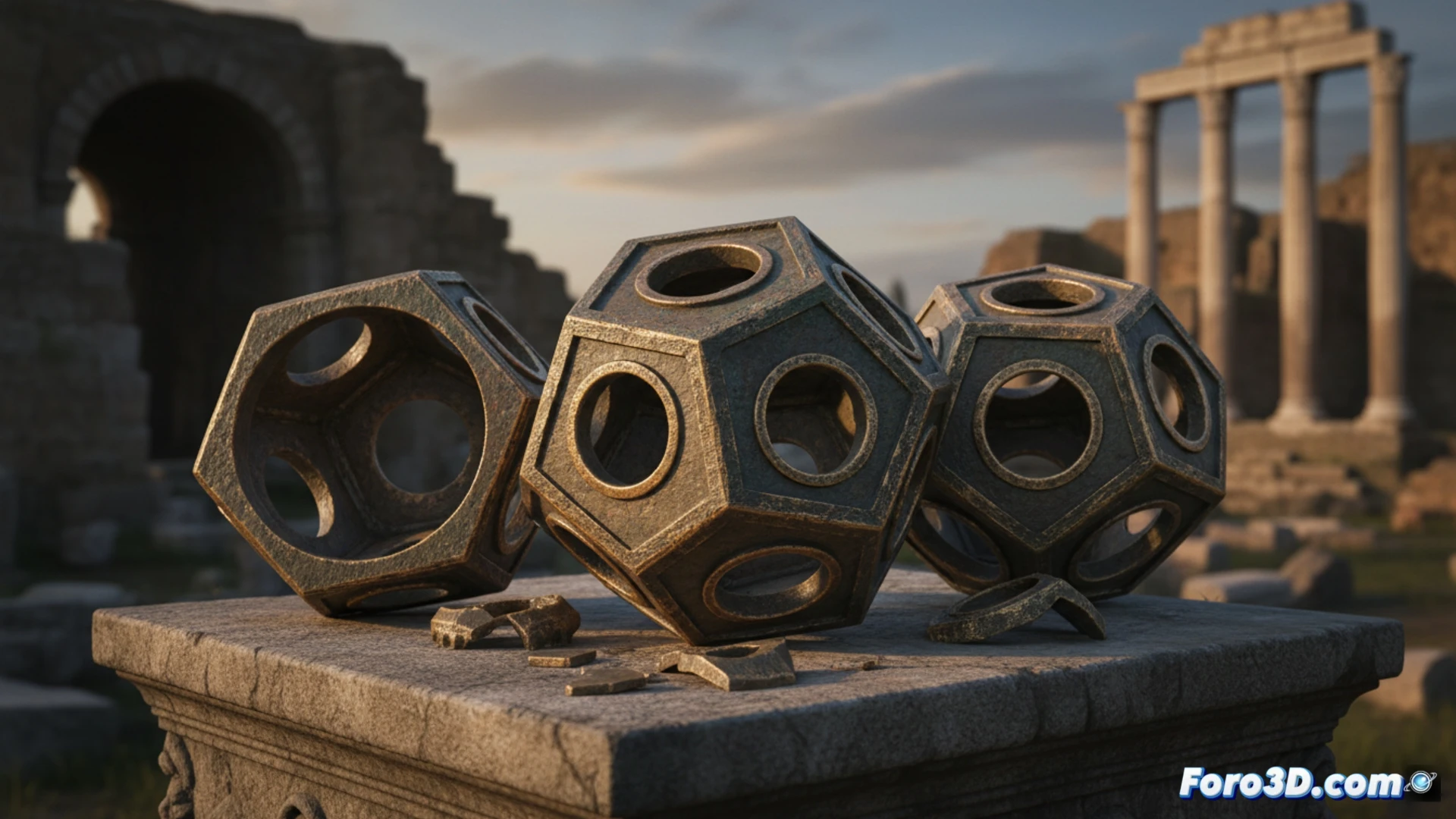
3D Scanning and Photogrammetry: The Revolution of Non-Invasive Analysis 🔍
The application of techniques like 3D laser scanning and photogrammetry has transformed the study of these objects. A precise digital model allows for a millimeter-level examination of their proportions, the differential wear on their vertices, or the analysis of manufacturing imperfections—crucial data for understanding their use. This digital replica becomes a permanent asset, preserving the exact state of the original against any future degradation. Furthermore, it facilitates the systematic comparison between the more than one hundred specimens found in different provinces of the Empire, searching for patterns hidden to the naked eye.
From Bit to Physical Object: Simulations and 3D Printing to Test Hypotheses 🧪
The 3D model is not an end, but the beginning of experimentation. With it, virtual simulations can be performed, such as fluid flow tests or ergonomic studies. But its most tangible potential comes with 3D printing. Producing an exact physical replica allows researchers to handle it, test practical hypotheses like its use for weaving or calibration, and share tactile copies with other experts. Thus, digital technology closes the circle, returning the enigma to the physical plane with new tools to, perhaps, finally find an answer.
How can the 3D digitization and computational analysis of Roman dodecahedrons scattered across Europe contribute new hypotheses about their function and cultural significance?
(PS: and remember: if you can't find a bone, you can always model it yourself)