Researchers at Oak Ridge National Laboratory have developed a revolutionary process for converting polyethylene into liquid fuels. The key lies in a mixture of molten salts with aluminum chloride, which acts as both a medium and a catalyst. This system breaks the polymer chains at temperatures below 200 °C, a significant advance compared to costly pyrolysis processes that require over 400 °C. The method promises to make the chemical recycling of plastics viable.
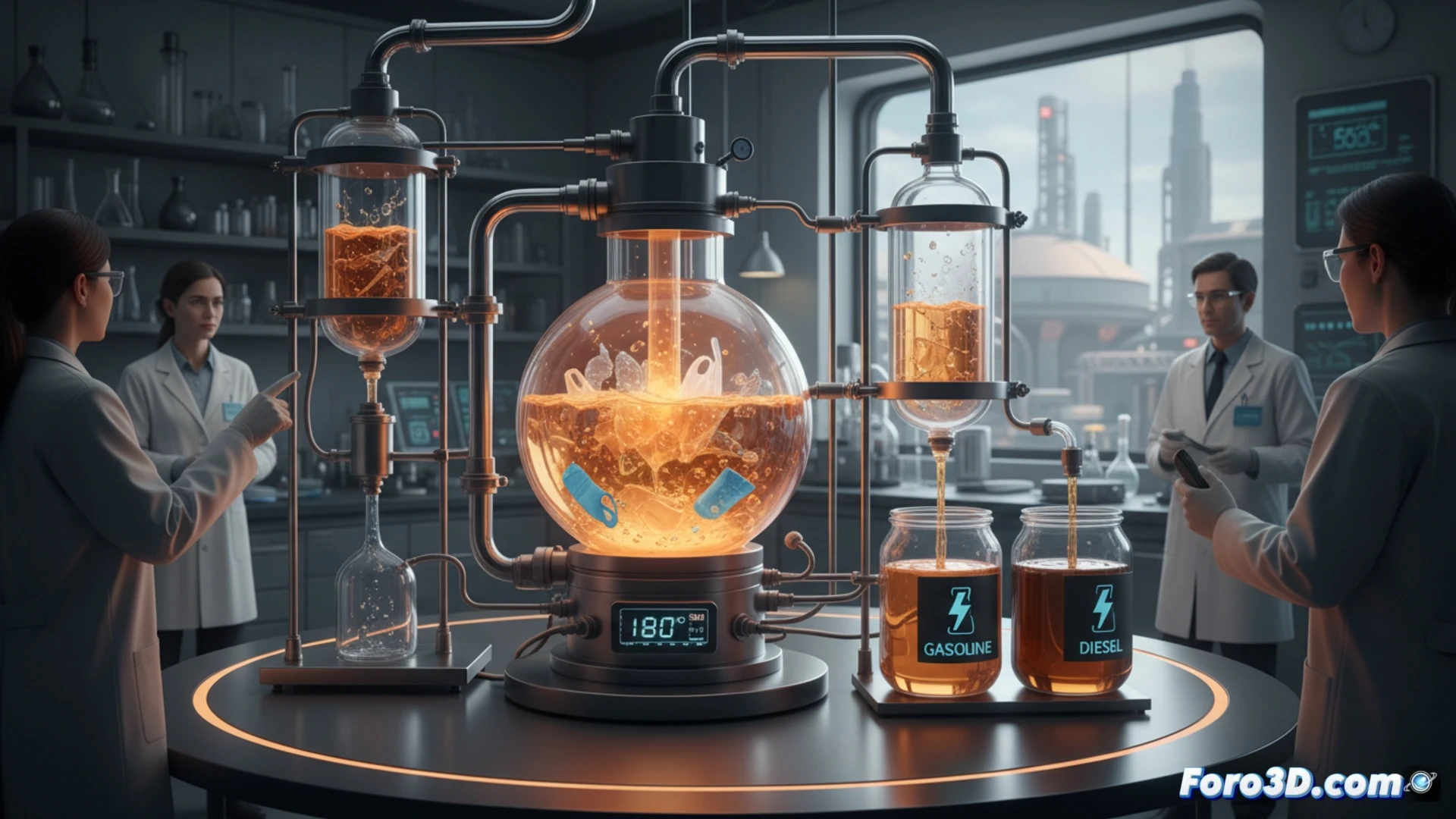
Visualizing Catalysis and Polymer Chain Breakdown 🔬
3D visualization is key to understanding this breakthrough. We can model the long linear chain of polyethylene, a repetitive structure of methylene groups. When introduced into the ionic bath of molten salts, the simulation shows how aluminum chloride ions coordinate and weaken specific carbon-carbon bonds. The catalytic breakdown occurs at random points, generating medium-length hydrocarbon fragments, corresponding to naphtha, gasoline, and diesel. Contrasting this animation with traditional pyrolysis, where intense and random heat causes chaotic breakdown and significant gas formation, underscores the selectivity and mildness of the new process.
Implications for Material Modeling and Recycling ♻️
This process is not just a chemical engineering achievement, but an ideal case study for computational materials science. Simulating the interaction between polymers and complex ionic media opens doors to designing new catalytic systems. The visual representation of the transformation from waste to resource is powerful, offering a clear roadmap for developing more efficient and less energy-intensive advanced recycling plants, bringing us closer to a real circular economy for plastics.
Could the decomposition of polyethylene into fuels using molten salts at low temperature be the key to a real circular economy for plastics?
(PS: Visualizing materials at the molecular level is like watching a sandstorm with a magnifying glass.)