Leonardo da Vinci is famous for the Mona Lisa, but his true obsession was engineering. In 1482, he presented himself to Ludovico Sforza listing his skills as a builder of bridges and war machines before that of a painter. His notebooks, filled with designs impossible for his time, were not mere doodles; they were tools of visual communication to challenge established knowledge, a direct precursor to the digital activism that uses 3D modeling today.
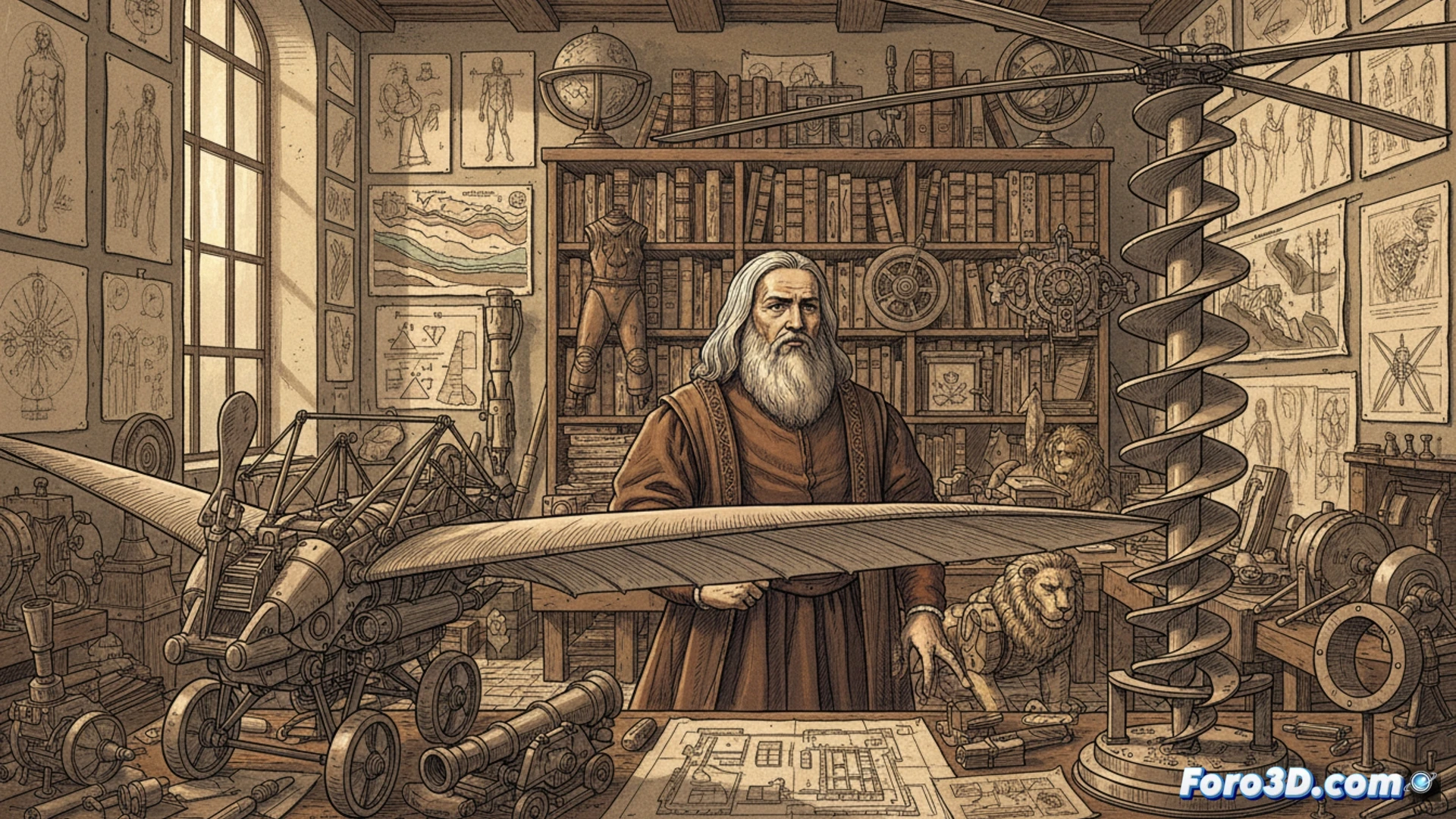
Engineering sketches as proto-3D infographics 🎨
Da Vinci's notebooks functioned as an idea laboratory where technical drawing replaced text. His studies of flight, anatomy, or hydraulics sought not only to understand nature but to demonstrate hypotheses impossible to validate with the technology of the time. Just as a digital artist today models a prototype shelter for climate crises in Blender, Da Vinci sketched helicopters and tanks. The difference is that he lacked rendering, but shared the same goal: to make the invisible visible to provoke a paradigm shift in thought.
Morality in the source code of the Renaissance ⚖️
Da Vinci did not separate technique from ethics. In his manuscripts, he included criticisms of war and theological reflections, using drawing as social protest. Today, digital activists use augmented reality to overlay political messages on historical monuments or create 3D infographics about ecological disasters. Both understand that the technical image, whether a pen sketch or a photorealistic render, is the most powerful vehicle to hack collective consciousness and sow uncomfortable questions.
As art and engineering merge today in digital activism, what techniques of Da Vinci could we reinterpret to design visual campaigns that denounce social issues with the same disruptive power as his inventions?
(PS: at Foro3D we believe that all art is political, especially when the computer freezes)