The Alcorcón Event and Activity Resource Complex, known as CREAA, is a perfect case study for urban disaster simulation. Conceived in 2004 as a Madrid-style Guggenheim, it integrated an auditorium, conservatory, and permanent circus across nine buildings. Construction began in 2007 but was halted in 2008 with 70% completion and a massive public debt. Today, its concrete and steel structure degrades irreparably, offering a perfect canvas for modeling contemporary ruins.
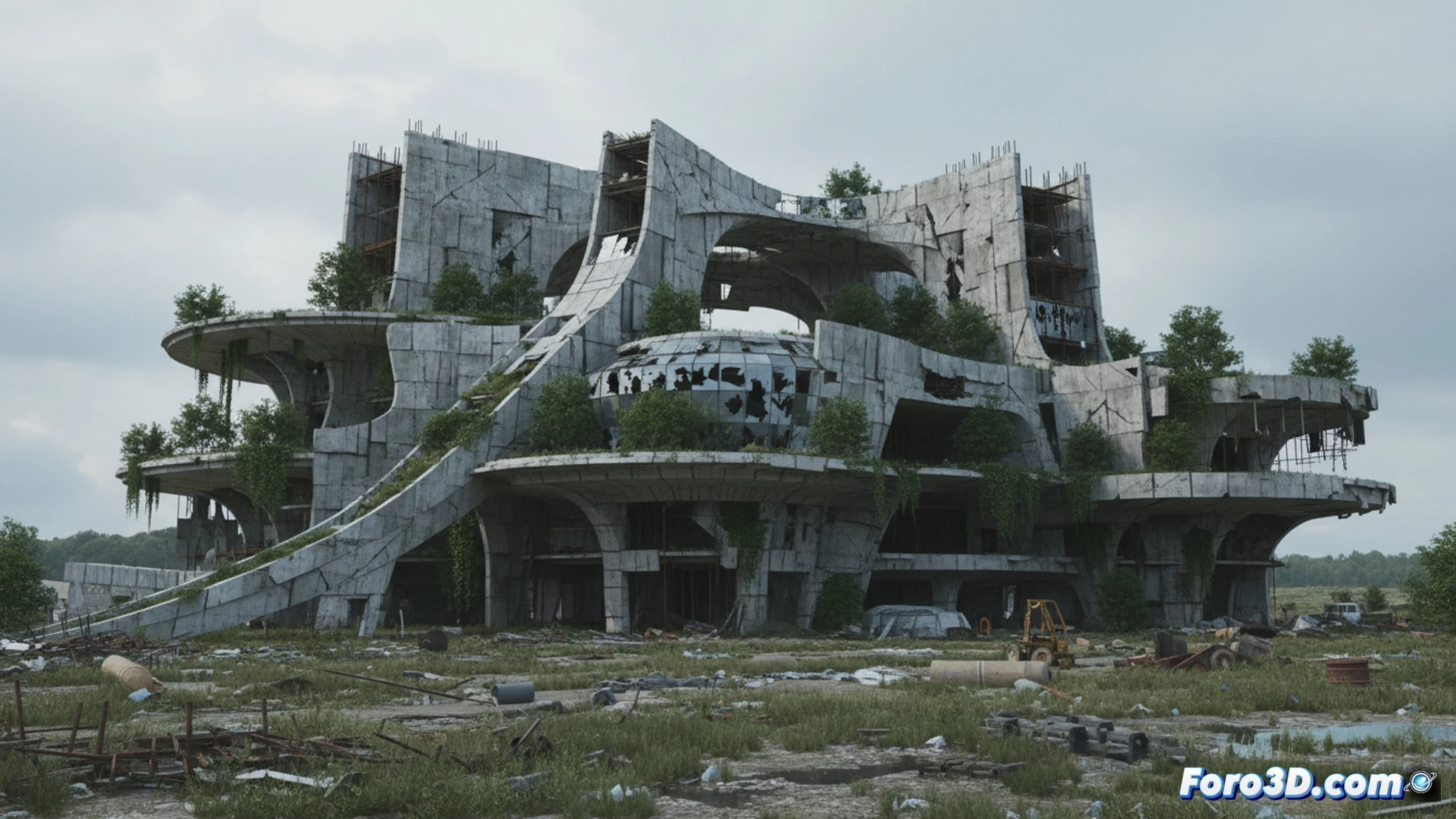
Digital reconstruction and structural degradation analysis 🏚️
For the 3D modeling of CREAA, the first step is photogrammetry of the fenced perimeter and reconstruction of the original volume based on the architectural firm's plans. The simulation must reflect the state of abandonment: fatigue cracks in the cantilevers of the convention center, oxidation of the metal trusses in the circus, and accumulation of debris in the animal stables, one of the most controversial decisions. The technical challenge is to replicate the failed integration of the buildings, where the demolition of a new library to unify the complex created weak structural joints. The visualization must show how the lack of climate control and stagnant water accelerate concrete carbonation, a process that makes any potential rehabilitation prohibitively expensive.
Lessons from a financial and spatial colossus 💸
CREAA is not just an unfinished building; it is a catalog of planning errors that any modeler should study. The debt of the public company created for its management exceeded projected revenues for decades, a common pattern in macro-projects like Sijori (Indonesia) or Castellón Airport. When simulating its urban impact, one observes how the concrete monster breaks the neighborhood's scale, creating an economic void that not even offers like Richard Gere's for a Buddhist center could fill. The lesson is clear: a design without modularity and with uncontrolled cost overruns is not an icon, but a programmed ruin.
As a 3D modeling expert, what disaster simulation techniques would you apply to represent structural collapse or mass evacuation in the CREAA macro-project in Alcorcón, and what real financial collapse data would you use to validate the realism of the animation?
(PS: Simulating disasters is fun until your computer melts down and you are the disaster.)