In Singapore, owning a car has ceased to be a matter of mobility and has become a marker of social status. This phenomenon is not accidental, but rather the result of an extreme regulatory system: the Certificate of Entitlement (COE). Implemented in 1990 to combat congestion and pollution, this permit has inflated the prices of ordinary cars to figures typical of supercars, exceeding 100,000 Singapore dollars in 2026.
3D Visualization of the Evolution of the COE and the Final Vehicle Price 🚗
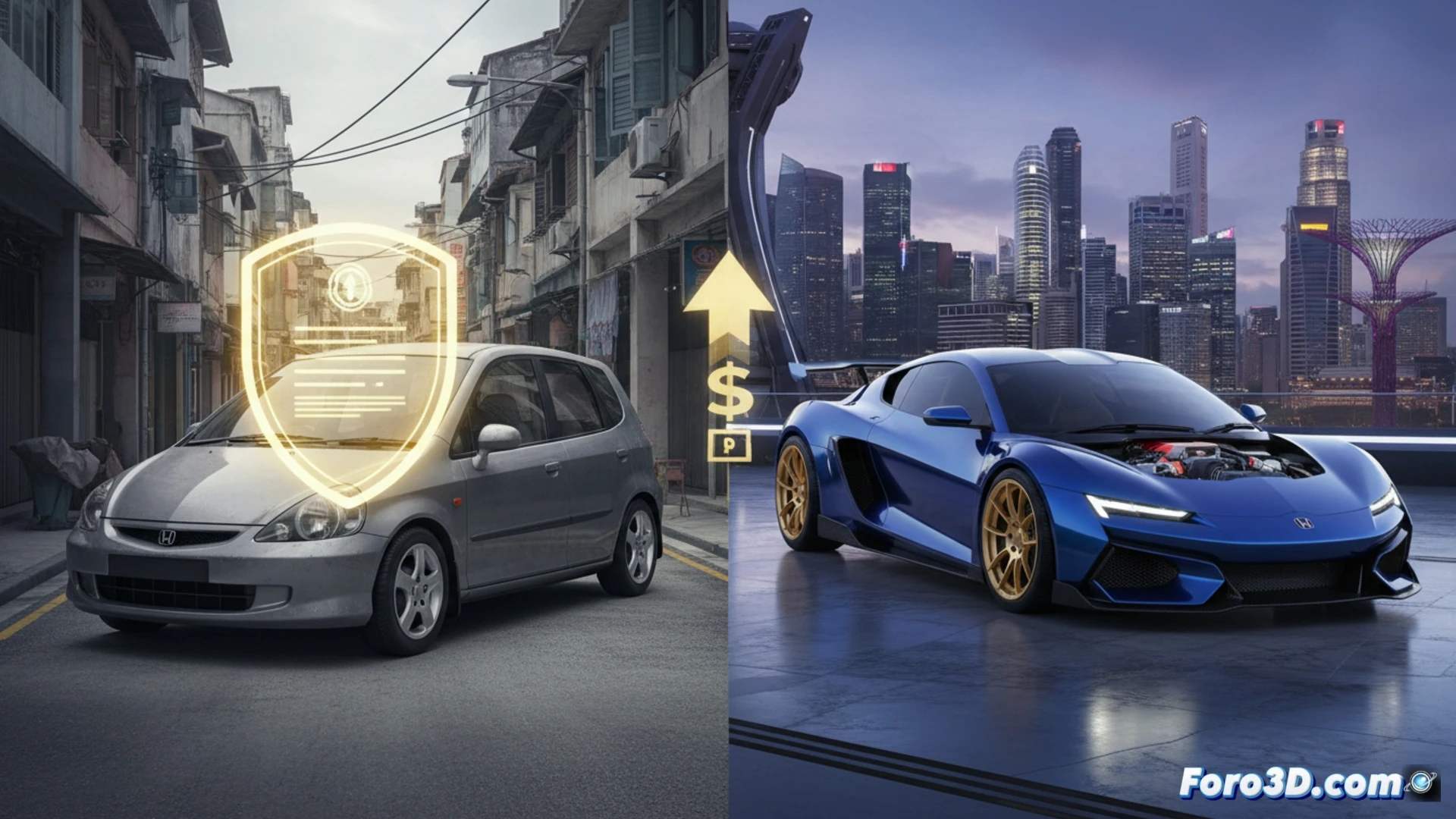
Our interactive model allows tracking the trajectory of the COE since its inception in 1990. The timeline shows exponential growth, with critical peaks in 2020 (84,000 USD) and a new record in 2026 (106,000 SGD). By overlaying this data with local GDP per capita, a growing gap is revealed: while disposable income grows linearly, the cost of car access skyrockets in a parabolic curve. The 3D model of a basic sedan, such as a Toyota Corolla, updates dynamically. When activating the COE slider, the bodywork visually transforms, adding carbon fiber details and a floating price that goes from 30,000 to 150,000 dollars, demonstrating that the vehicle appreciates as a luxury asset.
The Automobile as a Financial Asset in a Market of Limited Supply 💰
The paradox is evident: a mass-produced industrial good becomes a scarce object of desire, regulated by a quasi-state monopoly. The COE auction system limits supply to a fixed number of annual units, generating pent-up demand that bids prices up. This mechanism transforms buying a car into a speculative investment. In this context, the vehicle ceases to be a tool and becomes a symbol of purchasing power, comparable to a luxury watch or a bespoke suit, where the true cost is not the chassis, but the permit to display it.
In a market where the Certificate of Entitlement (COE) in Singapore can exceed 100,000 dollars, becoming the main cost of the vehicle, how does this economy of scarcity impact the design and manufacturing strategy of utility cars to turn them into luxury and status objects, and what lessons does it leave for the industry?
(PS: chip prices are rising like our electricity bill... and they look just as clear)