A large billboard collapsed onto a road during a gale, blocking traffic and causing material damage. Authorities suspected that the original design did not account for lateral gusts, prompting a forensic investigation based on digital twins. The team scanned the deformed structure with an Artec Leo to capture its actual post-collapse geometry, then subjected it to a virtual wind tunnel using CFD in SimScale, and finally analyzed the anchors in SAP2000.
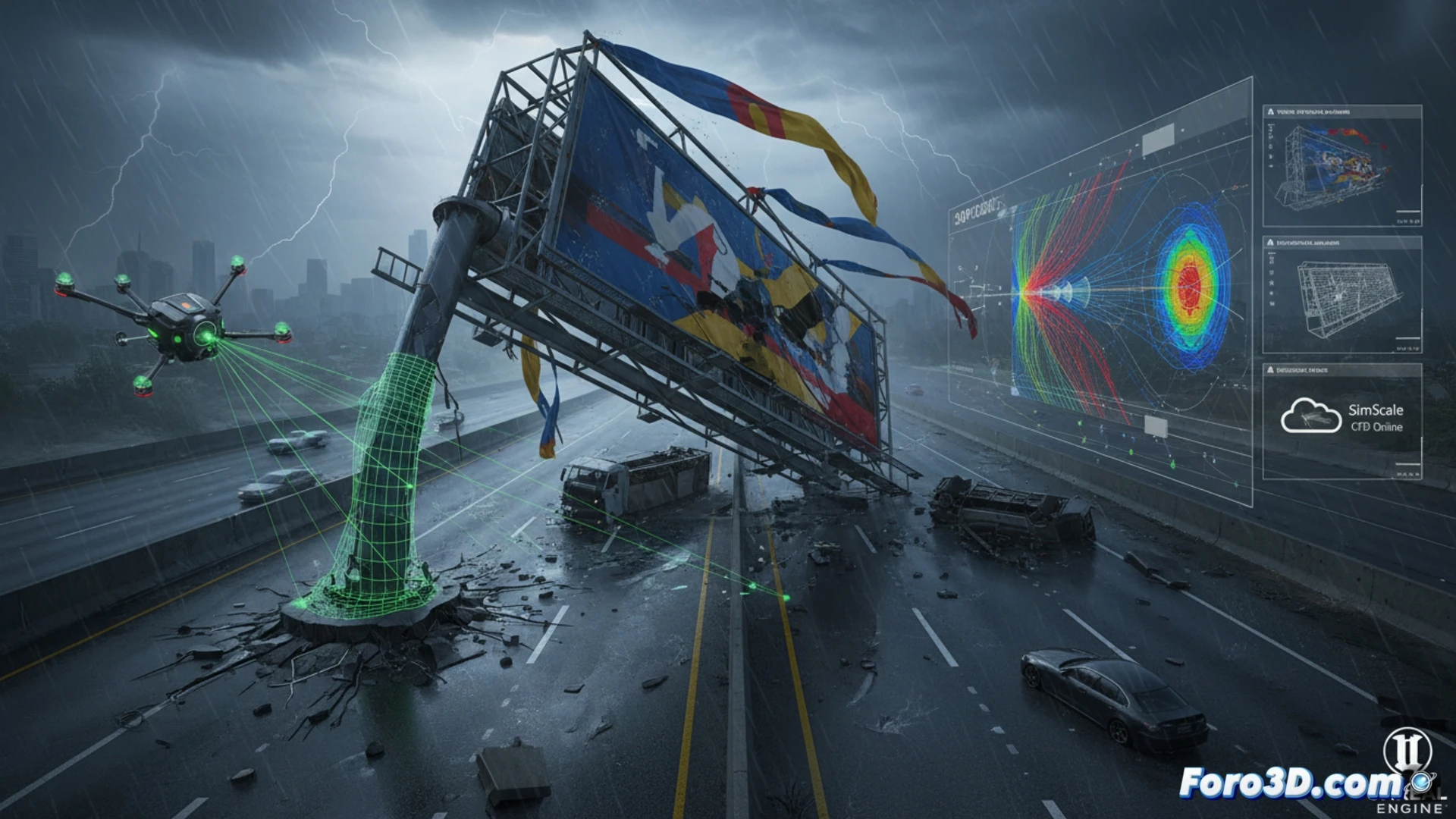
Forensic workflow: scanning, CFD, and structural analysis 🌪️
The process began with 3D scanning of the fallen billboard using an Artec Leo, which recorded every plastic deformation and twist in the metal profiles. That point cloud was imported into SimScale to run CFD simulations with winds of up to 120 km/h in a lateral direction, replicating the accident conditions. The results showed dynamic pressures 40% higher than those estimated in the original calculation. Then, in SAP2000, the anchors were modeled with the actual CFD loads, revealing that the fastening bolts had a safety factor of only 0.8, well below the required minimum of 1.5. The digital twin confirmed that the failure was not due to panel fatigue, but to insufficient anchors against unforeseen lateral gusts.
Lessons for regulations and structural design 🔧
This case demonstrates that current regulations underestimate variable wind loads on advertising structures, especially in urban environments with a canyon effect. The combination of 3D scanning, CFD, and structural analysis allows for precise identification of where the design failed and for proposing specific improvements, such as increasing bolt diameter and adding transverse reinforcements. Adopting this forensic workflow as a post-collapse standard not only clarifies responsibilities but also drives regulatory updates that save lives.
Which design factors in billboard anchors are often overlooked when calculating lateral wind loads, and how could they prevent similar collapses in areas with unpredictable gusts?
(PS: Simulating a collapse is easy. The hard part is keeping the program from crashing.)