A moderate-intensity volcanic eruption near a scientific facility caused the total collapse of its geodesic dome. What seemed like a simple dust accumulation problem turned into a forensic case study. Engineers, surprised by the magnitude of the failure, turned to a digital workflow that combined aerial photogrammetry with parametric simulation to understand why a structure designed to withstand hurricane-force winds gave way under the weight of volcanic sediment.
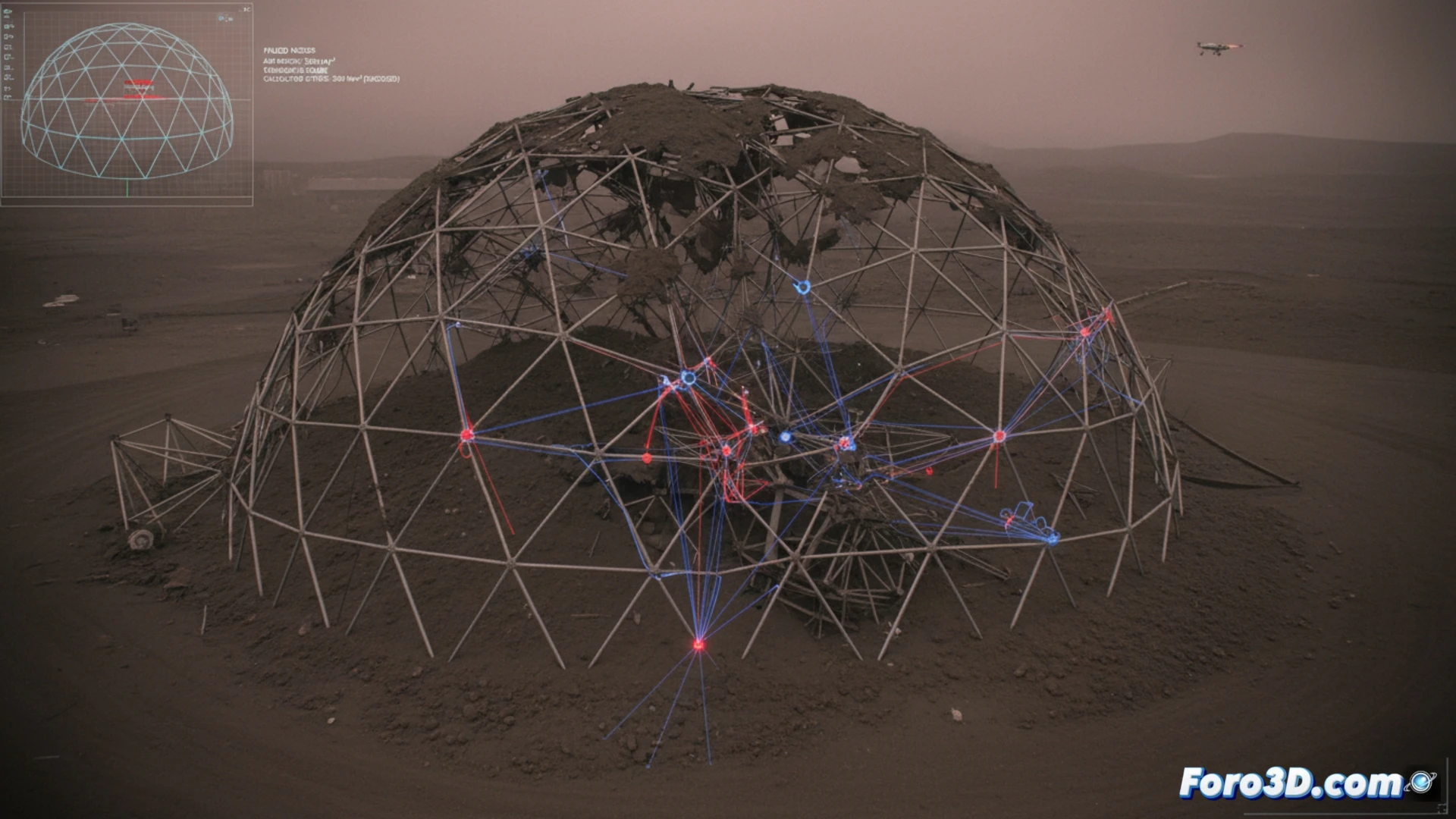
Photogrammetry and parametric simulation for forensic analysis 🌋
The analysis team used a drone to capture hundreds of images of the disaster site. With Pix4Dmapper, they generated a detailed 3D model of the ash mound covering the dome's remains. This model allowed them to accurately calculate the volume and density of the deposited material, yielding an unexpected total weight of 47 tons. Subsequently, in Tekla Structures, the original stress nodes from the CAD design were reviewed. The surprise came when loading this data into Rhino/Grasshopper for a parametric simulation: the ash did not accumulate uniformly but formed an eccentric wedge on the face exposed to the volcanic wind. This asymmetric distribution generated torsional moments at the nodes that exceeded the load capacity foreseen in the original static calculation by 300%, causing a cascading failure of the steel connectors.
Structural lessons for a volcanic world 🏗️
This case demonstrates that traditional CAD models fail by ignoring dynamic and irregularly distributed loads like ash. The integration of aerial photogrammetry with parametric simulation not only served to solve the mystery of the collapse but establishes a new prevention protocol. Now, designers of structures in risk zones can simulate non-uniform accumulation scenarios in Grasshopper before building, adjusting stress nodes in Tekla to withstand the unpredictable. 3D technology thus becomes the best forensic and resilient design tool against natural disasters.
What structural factors of the geodesic dome were decisive in its collapse under volcanic ash accumulation, according to the 3D analysis of the load simulation.
(PS: Simulating catastrophes is fun until the computer melts down and you are the catastrophe.)