A team led by Gary Melnick has mapped vast interstellar ice clouds spanning hundreds of light-years in the Milky Way, according to a study in The Astrophysical Journal. These clouds envelop two active star-forming regions: Cygnus X and the North America Nebula. The findings, obtained with NASA's SPHEREx space telescope, offer the most extensive picture to date of the distribution of cosmic ice, adhered to dust particles.
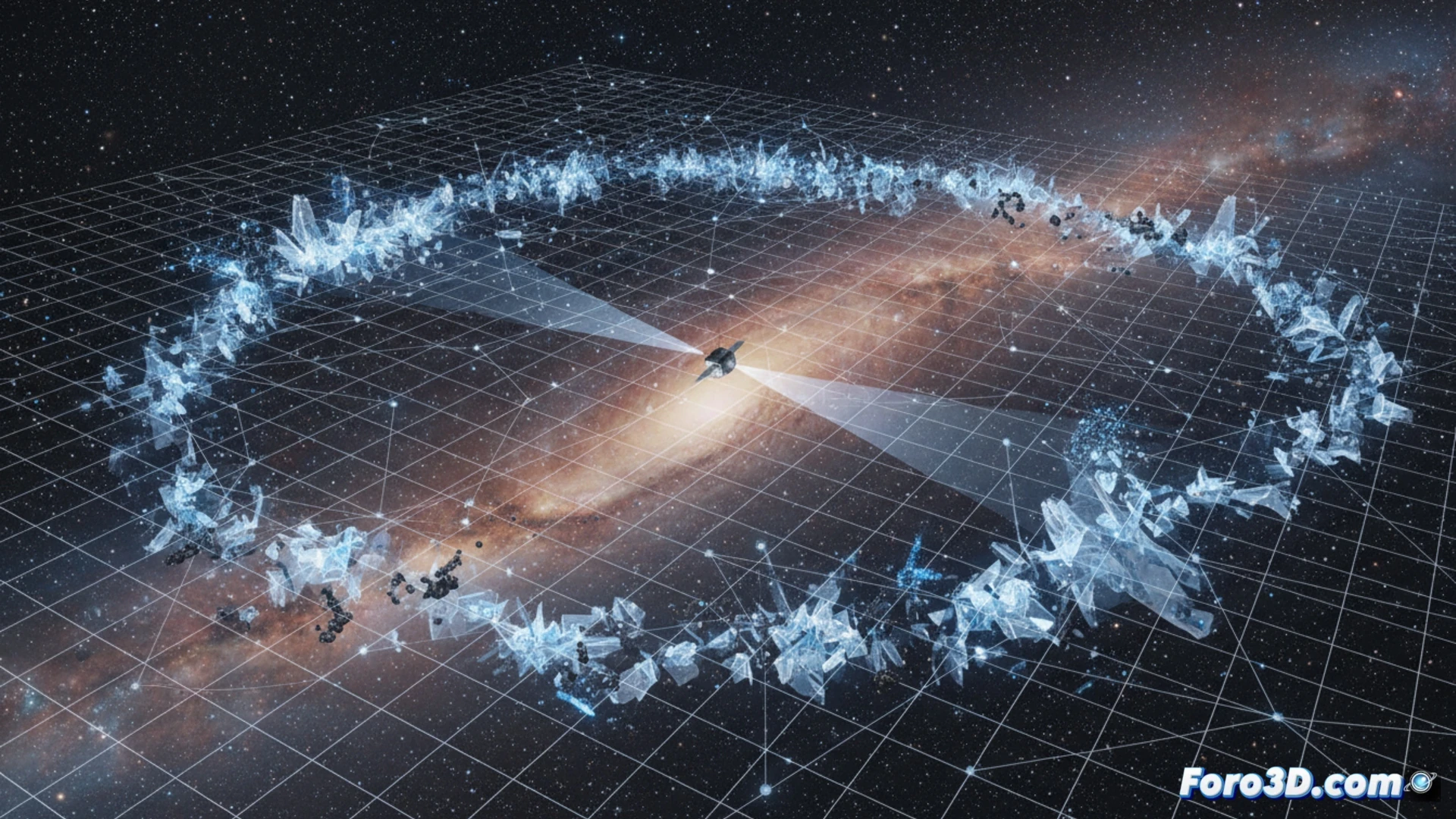
Data Visualization: Panoramic View vs. Local Detail 🌌
The technical challenge for scientific visualization is to represent the duality of scales. While the James Webb telescope generates high-resolution but narrow-field maps, SPHEREx provides a panoramic view tens of times wider. An interactive 3D infographic should show SPHEREx's massive coverage as a semi-transparent volume enveloping Cygnus X and the North America Nebula. Upon zooming in, Webb's detailed maps would be revealed as embedded windows, allowing the user to toggle between the global view of ice and the fine texture of dust.
The Cosmic Water Cycle in 3D 💧
The key animation must illustrate the mechanics of the origin of Earth's water. Ice adheres to cosmic dust grains, forming icy mantles. As stars are born, the gravitational collapse of the cloud drags these grains along. The visualization should show this accretion, with ice-coated dust particles spiraling down into a protoplanetary disk. There, the ice sublimates and condenses onto rocky planets, suggesting that much of Earth's water could have this interstellar origin.
How were 3D visualization techniques applied to represent the interstellar ice clouds, and what specific rendering challenges does the scale of hundreds of light-years in SPHEREx pose for the scientific analysis of the cosmic origin of water?
(PS: modeling manta rays is easy; the hard part is making them not look like floating plastic bags)