The discovery of a new predatory gastropod in the reefs of New Caledonia has revolutionized malacology. This turrid, armed with radular teeth modified into harpoon-like shapes, injects a neurotoxic venom to immobilize its prey. For scientific visualization specialists, this finding represents a fascinating technical challenge: reconstructing in 3D a hunting mechanism that combines precision biomechanics with evolutionary toxicology. 🐌
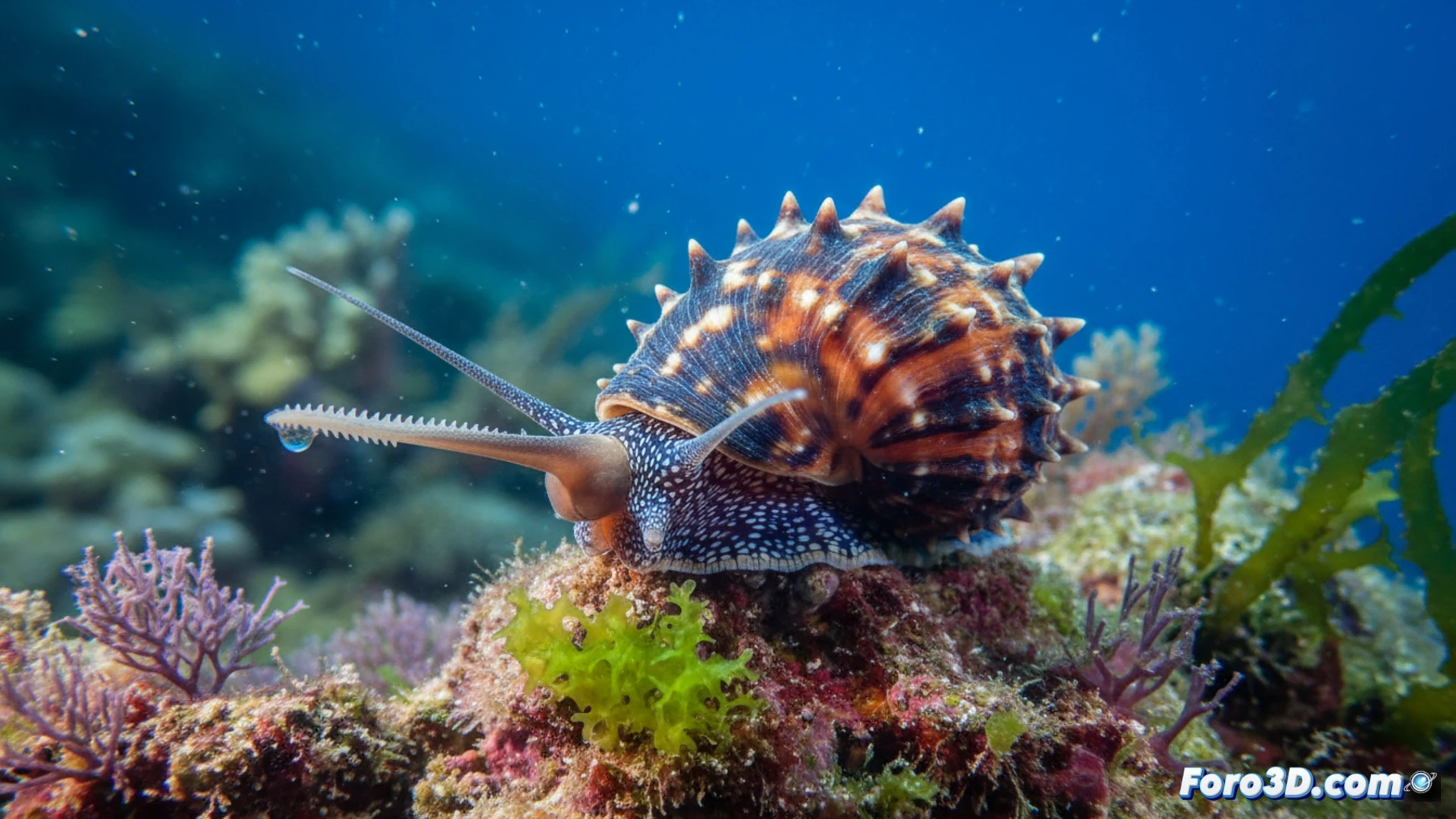
Anatomical reconstruction of the radular apparatus and venom modeling 🔬
The 3D model must prioritize the representation of the radula, a chitinous organ that in this species features hollow hypodermal denticles. These teeth, similar to micro-syringes, project forward in a ballistic movement. For accurate visualization, we recommend using high-resolution photogrammetry of the shell together with micro-computed tomography (micro-CT) of the soft tissues. The simulation of venom flow through the tooth canal can be achieved using dynamic particles in Blender or Houdini. Comparatively, this mechanism is more specialized than that of other turrids in the Indo-Pacific, justifying an extremely detailed model of the harpoon filament.
From the reef to the virtual laboratory: the value of scientific visualization 🌊
This model not only satisfies the curiosity of seashell enthusiasts but also allows biologists to study the kinematics of the attack without dissecting live specimens. By integrating the model into a virtual reality environment, the ecosystem of the coral seabeds of New Caledonia can be simulated, observing how the snail detects its prey through chemoreception. Science communication gains an immersive tool that explains the convergent evolution of these snails with structures similar to those of frogfish or jellyfish.
How can I 3D model the complex shell geometry of the new turrid from New Caledonia to simulate its predatory biomechanics in a scientific visualization environment?
(PS: if your manta ray animation doesn't excite, you can always add documentary music from channel 2)