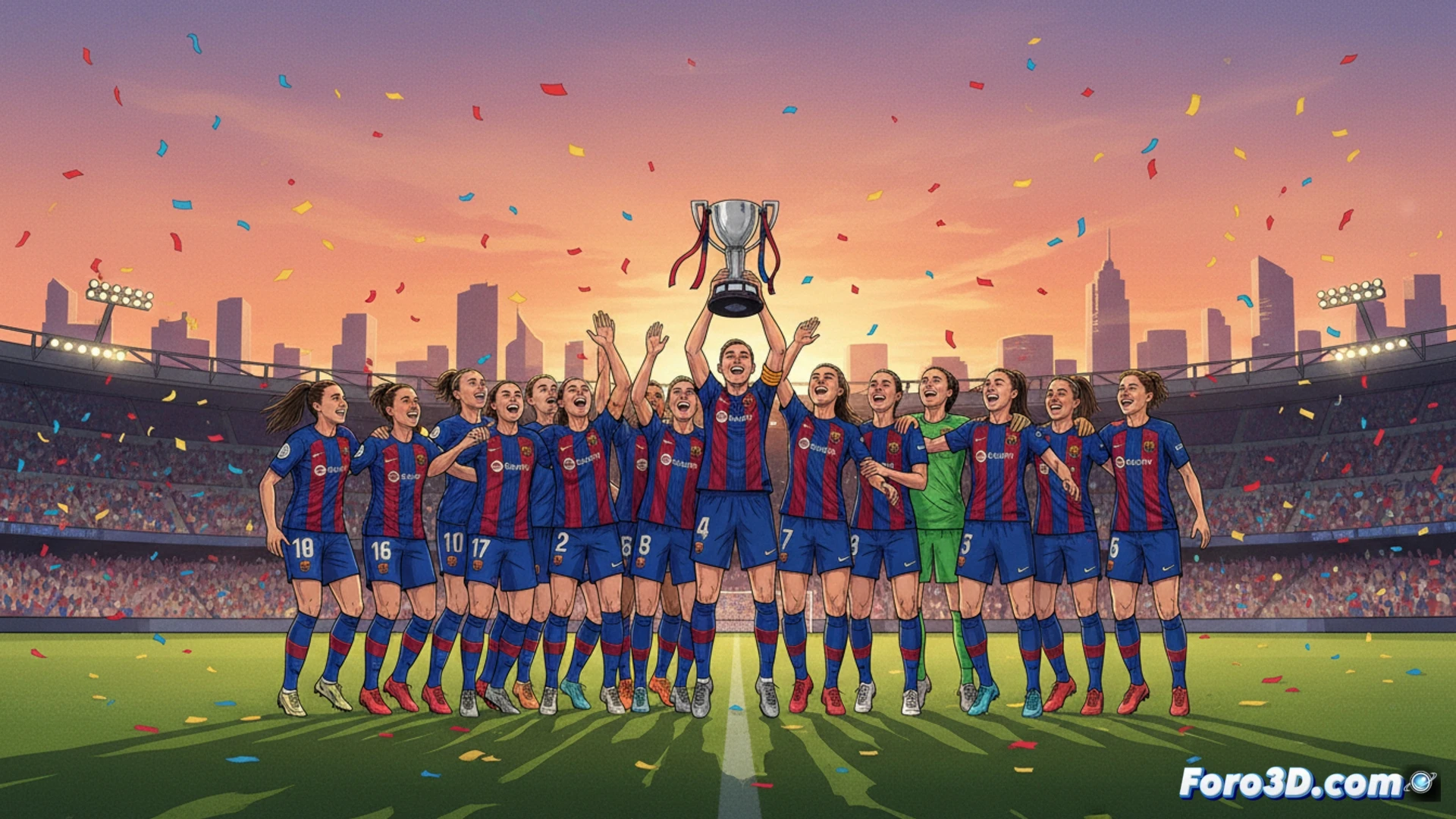
FC Barcelona Femení has achieved a historic milestone by winning its seventh consecutive Liga F, the eleventh in its history, after defeating RCD Espanyol 1-4. Beyond the statistical data, this absolute dominance can be broken down using 3D technology, a key tool for understanding the tactical and physical superiority of Pere Romeu's team. We analyze the key plays of the decisive match at the Ciutat Esportiva Dani Jarque.
3D Reconstruction of the First Goal Play 🏆
Volumetric reconstruction technology allows us to break down the action that opened the scoring. Through motion capture and three-dimensional models, we can see how Barça's high press forced Espanyol's turnover. The simulation shows the striker's breaking run, the exact angle of the through pass, and the low finish. This type of analysis, used by the coaching staff, allows movement patterns to be replicated in training. The 3D visualization of the goal reveals the millimeter-perfect synchronization between the assister and the scorer, a differentiating factor repeated throughout the 26 matches of the season.
The Evolution of an Empire in Three-Dimensional Data 📊
The 3D comparison of the seven consecutive seasons shows a brutal evolution. Heat maps generated by tracking software indicate that the team has increased its pressure in the opponent's half by 15%. Physical performance graphs, modeled in 3D, show an improvement in speed peaks and recovery between efforts. This dominance is no coincidence: it is the result of planning where 3D technology allows visualizing each player's workload and adjusting loads to arrive perfectly for each league fixture.
How has data visualization and 3D technology contributed to analyzing the tactical evolution of Barça Femení during its seven consecutive league titles?
(PS: at Foro3D we know that a penalty simulated in 3D always goes in... unlike in real life)