A child suffered severe foot injuries when their footwear became trapped at the end of an escalator. The incident, which occurred in a shopping center, triggered a forensic investigation protocol where 3D scanning and finite element simulation proved crucial. The objective was to determine whether the gap between the comb teeth and the steps exceeded regulatory limits due to wear or poor maintenance.
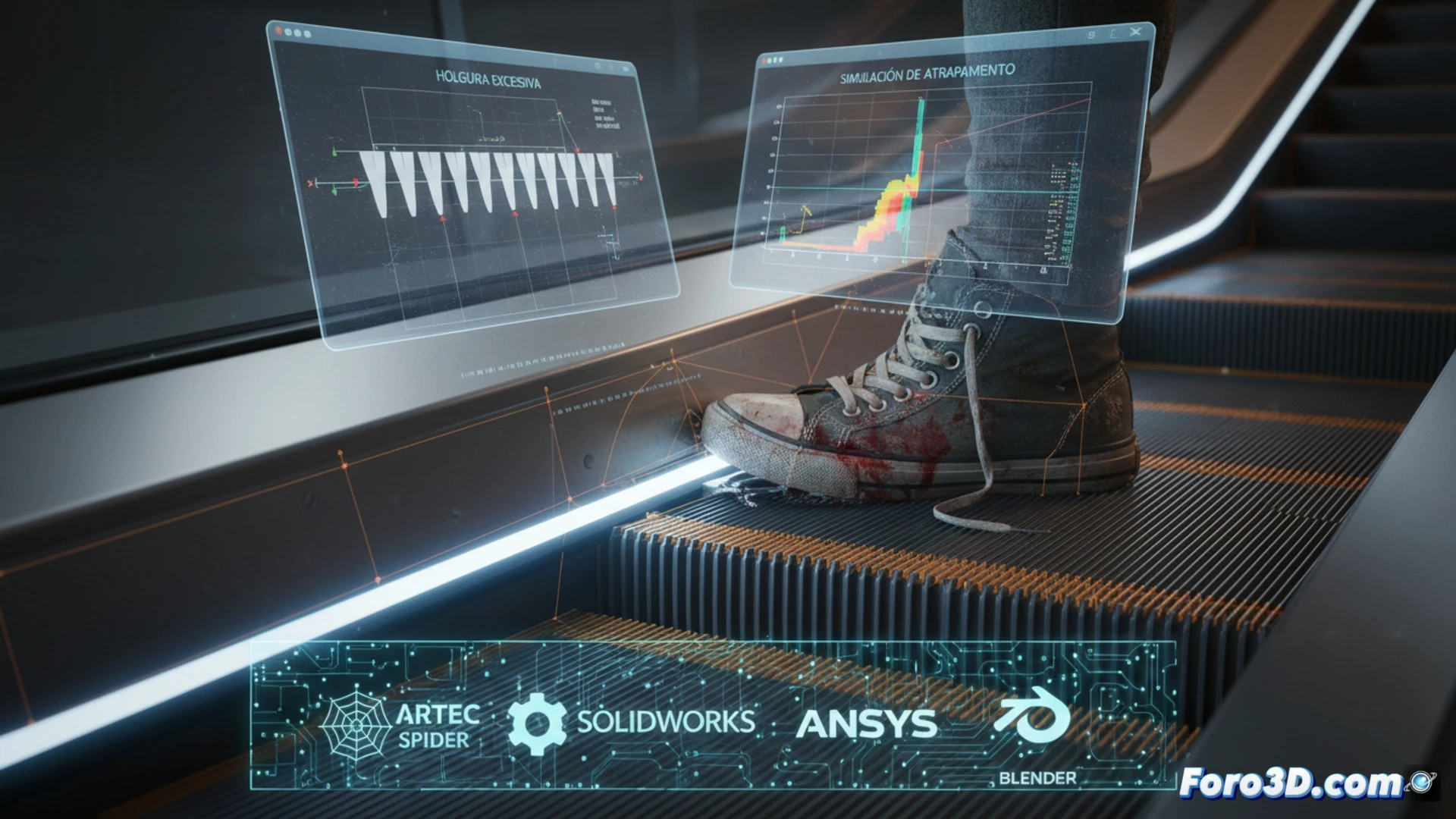
Forensic pipeline: from scanning to mechanical simulation 🛠️
The process began with capturing the internal mechanism using an Artec Space Spider scanner, obtaining a high-resolution point cloud (0.1 mm) of the landing plate and combs. This model was imported into SolidWorks to reconstruct the exact geometries of the teeth and steps. The actual gap between both surfaces was measured at various positions in the cycle. With this data, a structural analysis was performed in Ansys, simulating the trapping force on a model of children's footwear. The simulation revealed that the separation exceeded the maximum allowed by the EN 115-1 standard by 2.3 mm, indicating critical wear on the combs.
Forensic animation as conclusive evidence 🎥
Finally, a forensic animation was generated in Blender recreating the moment of entrapment, showing how the footwear entered the enlarged gap. The visual sequence allowed experts and the court to understand the mechanical sequence of the failure. The report concluded that the lack of periodic replacement of worn combs was the direct cause of the accident, establishing liability for the maintenance company.
Would you use a laser scanner or photogrammetry to document this case?