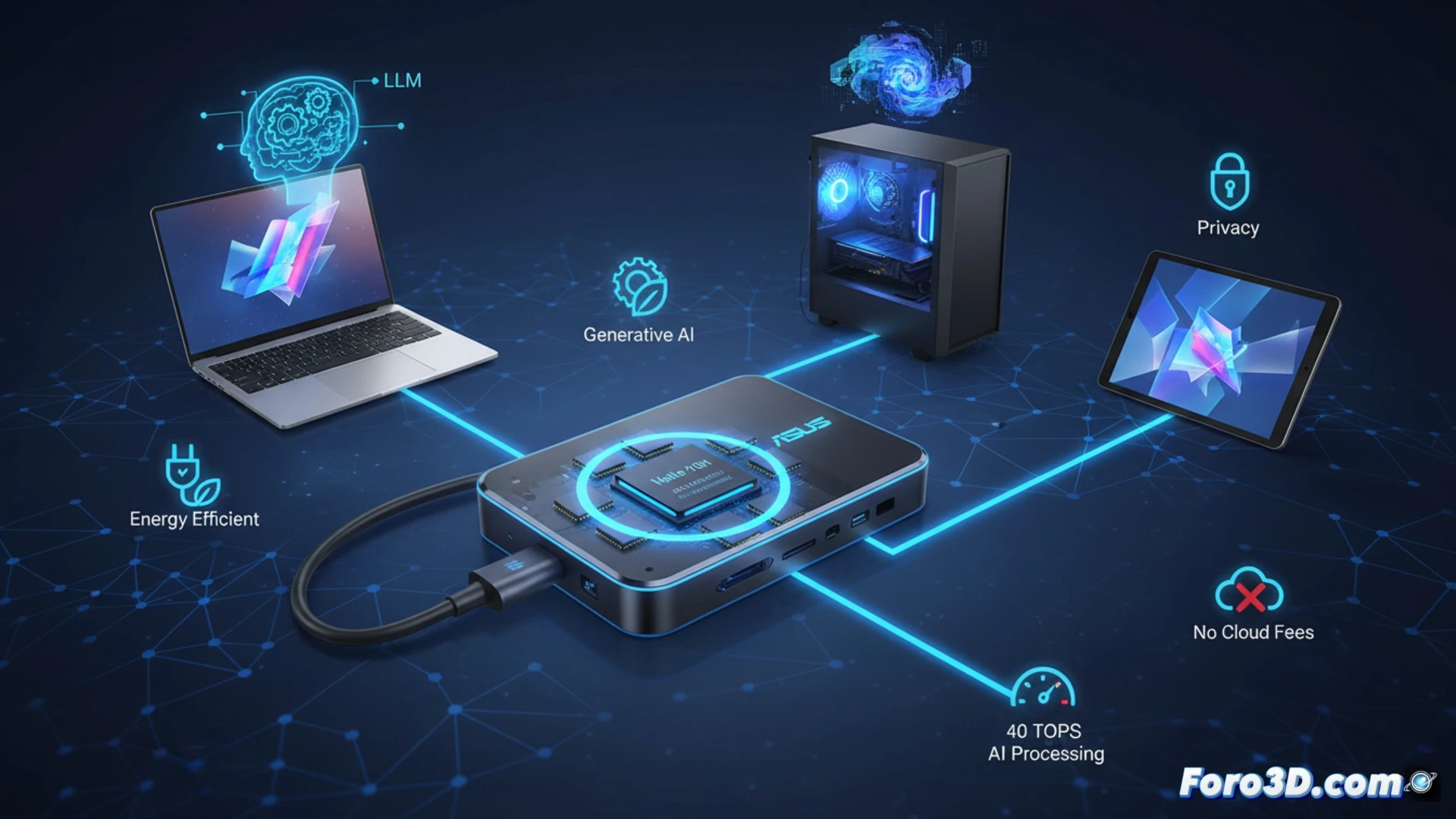
ASUS presents the UGen300, a device that promises to add up to 40 TOPS of AI power to any system via USB-C. For the 3D professional, an immediate question arises: can this external accelerator relieve the GPU in tasks like AI denoising, texture upscaling, or hybrid rendering? We analyze its real potential in workstations lacking an integrated NPU, evaluating whether it is a practical solution or a peripheral with limitations.
Specifications and USB-C Bottleneck 🔍
The heart of the UGen300 is the Hailo-10H chip, with 8 GB of dedicated LPDDR4 memory. Its 40 TOPS are theoretical power, but the USB-C 3.2 Gen 2 connection can be a severe limitation. For 3D inference tasks, such as NVIDIA's OptiX denoising or AI upscaling, bandwidth can throttle performance, especially when transferring large image buffers or complex meshes. While an internal NPU operates with minimal latency, this device relies on the USB bus, sharing bandwidth with other peripherals. Its advantage is offloading the main CPU/GPU, but the bottleneck is inherent.
Investment versus GPU Upgrade 💰
The key decision is economic. The UGen300 will be a niche solution: useful for laptops or older PCs where a GPU upgrade is impossible or very expensive. For a dedicated workstation, investing in a modern GPU with tensor cores and greater internal bandwidth will almost always be superior. Its real value in 3D could lie in AI-specific pre/post-production processes, run in the background, as long as data transfers do not dominate the total time. It is an interesting concept, but with practical limitations for intensive workflows.
Can the ASUS UGen300 become a key tool for accelerating pre-rendering tasks, denoisers, and simulation in professional 3D workflows?
(PS: RAM is never enough, like coffees on a Monday morning)