The ASUS ROG Zephyrus Duo 2026 has arrived to challenge the logic of professional mobility. With its two massive screens and high-end hardware configuration, it promises to be a portable workstation for 3D modeling and simulation. However, with a weight of 6.17 pounds and a thickness nearing an inch, this gaming laptop raises a key question for digital artists: is it a viable tool for on-the-go work or just a disguised desktop? 🖥️
Technical analysis: Raw power vs. Transport ergonomics 🎒
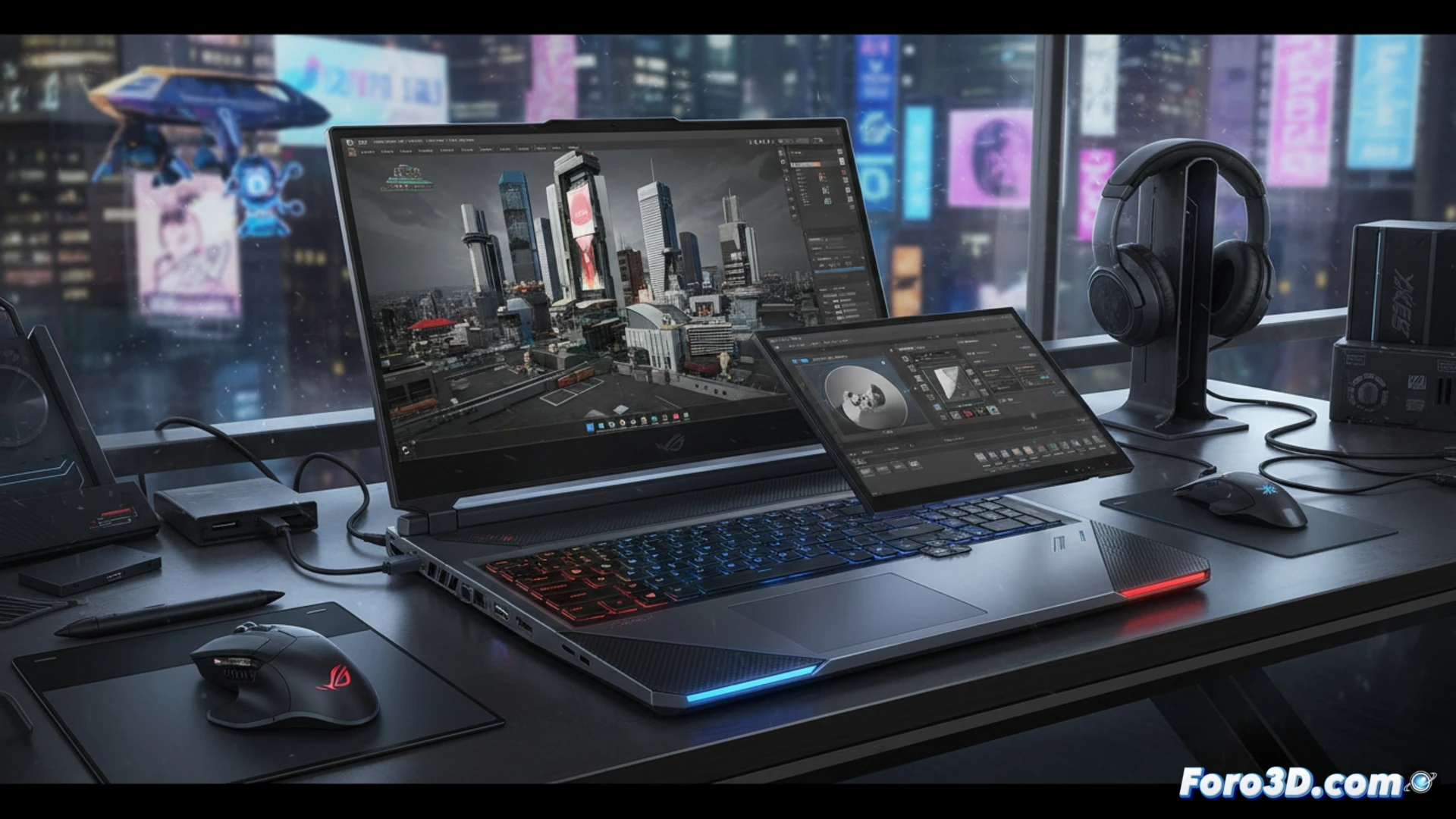
For a 3D workflow, the Zephyrus Duo's dual screen is a magnet. Having the timeline, material nodes, or simulation windows on the secondary screen while modeling on the main one is a luxury few laptops offer. However, that versatility comes at a severe physical cost. Compared to a ThinkPad X13 Gen 6 or a Samsung Galaxy Book6 Pro, this device triples the weight, eliminating any pretense of real mobility. If your studio is in your backpack, this monster will break your back. The battery, moreover, drains quickly under render load, tethering it to a power source. The detachable keyboard, a rarity, adds a point of fragility to an already bulky device.
Verdict: Workstation or luxury showcase? ⚖️
The Zephyrus Duo 2026 is a beast designed for those who don't need to leave their desk. If you're a 3D professional working from home or a fixed office, its power and dual screen can justify the price and bulk. But if your daily routine involves changing locations, client meetings, or fieldwork, its weight makes it an anchor. The power is there, but portability is not. It's a device to admire, but not to carry around.
How does the dual screen of the ASUS ROG Zephyrus Duo 2026 affect the workflow in 3D modeling and rendering applications, or does it become more of a distraction than a real advantage for professional productivity
(PS: remember that a powerful GPU won't make you a better modeler, but at least you'll render your mistakes faster)