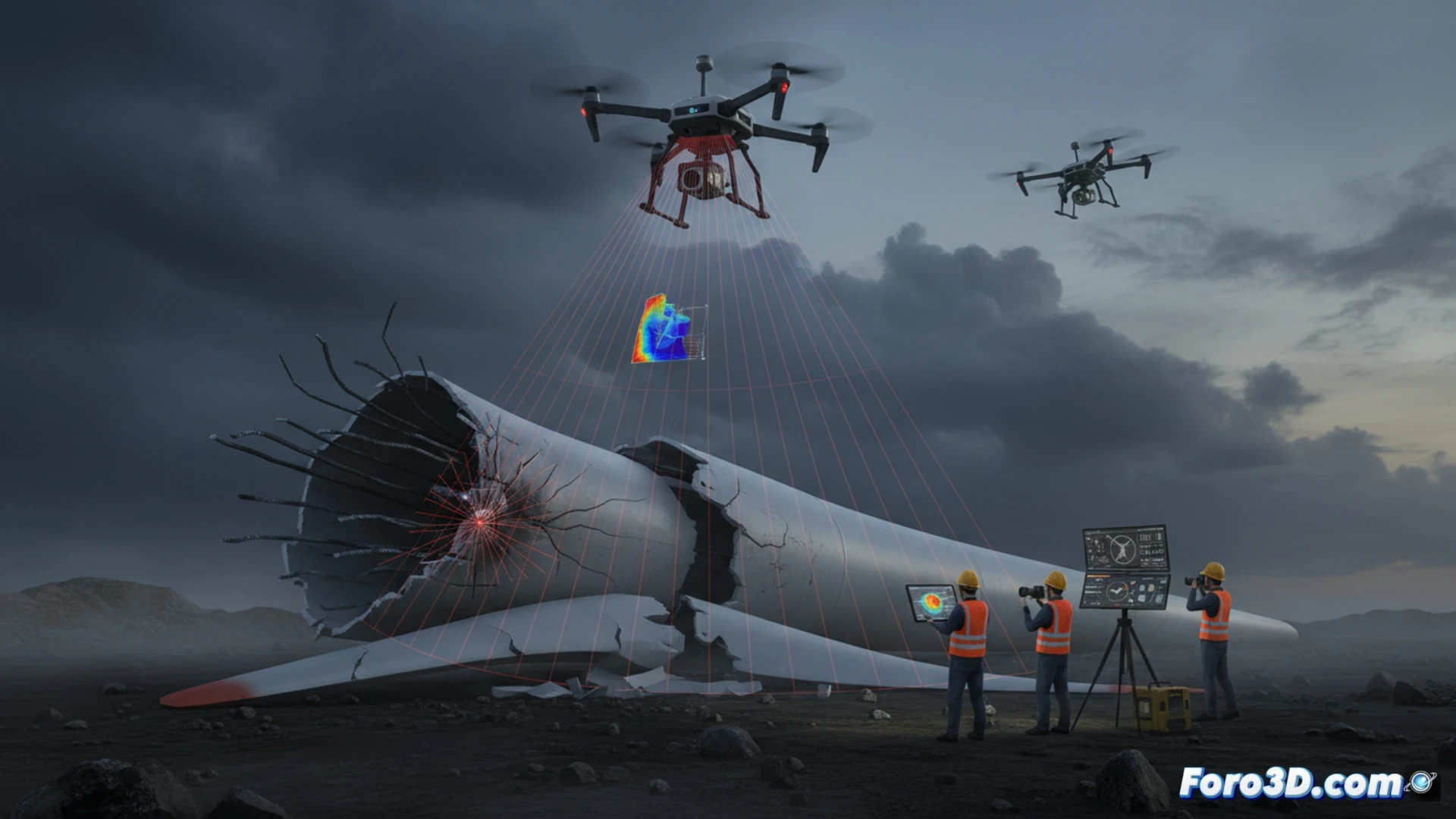
The collapse of an offshore wind turbine after a storm triggers a crucial forensic investigation. The goal is to determine if the cause was a progressive failure due to material fatigue or a sudden event. To resolve it, a team of drones equipped with thermal cameras and LiDAR sensors is deployed, whose mission is to capture every detail of the damage and build a precise three-dimensional digital model of the affected blade.
Integrated methodology: from 3D scanning to physical simulation 🔍
Photogrammetry with Pix4Dmapper and LiDAR data generate an exact point cloud of the damaged blade. In CloudCompare, this model is compared with the original CAD design, quantifying deformations and locating the epicenter of the failure. The hypothesis of a lightning strike impact is validated with COMSOL Multiphysics, simulating the electrical discharge through the grounding system and the explosive heating of internal moisture. This electromagnetic-thermal simulation reproduces the observed sudden delamination, ruling out fatigue as the primary cause.
Lessons for resilient renewable design 💡
This case underscores the value of digital forensic engineering. The integration of 3D capture techniques and advanced simulation not only diagnoses failures with precision but also provides critical data to improve components. The lesson is clear: reinforcing lightning protection and managing moisture in blades is essential to increase the reliability of offshore wind energy in the face of extreme events.
How can fatigue simulation discriminate whether a wind turbine blade collapse was due to lightning strike damage or a pre-existing material fatigue failure?
(PS: Material fatigue is like yours after 10 hours of simulation.)