An electronic cigarette exploded in a user's hand, causing serious injuries. To determine the root cause of the accident, a forensic workflow based on 3D technology was employed. The damaged device was scanned using computed tomography, revealing a critical design flaw in its safety system. This case study illustrates how reverse engineering and digital analysis are key to investigating product failures.
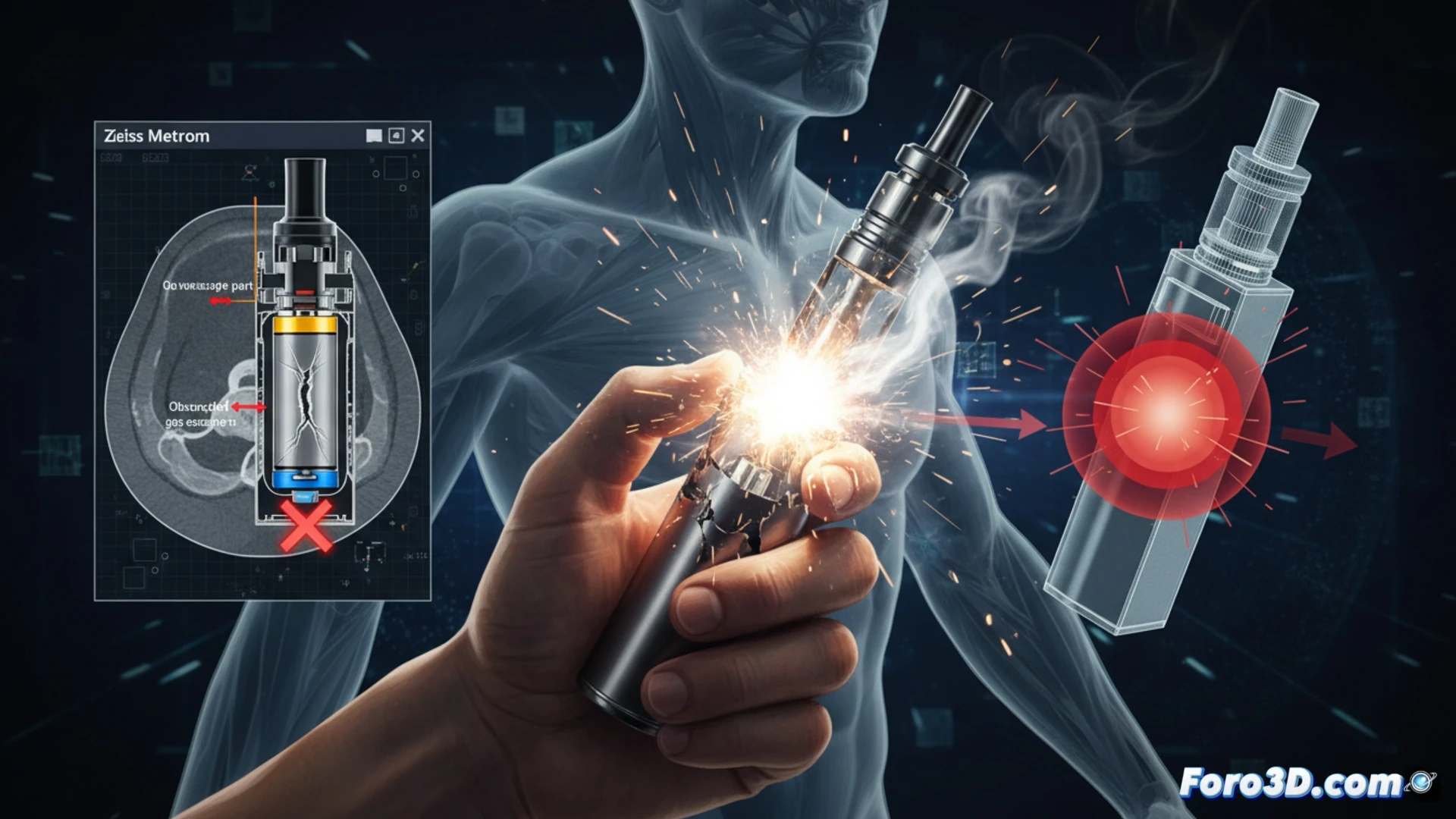
Technical Methodology: From Tomography to Forensic CAD Model 🔬
The process began with data acquisition on the Zeiss Metrotom computed tomography scanner, which generated a high-resolution 3D volume of the damaged vape without altering its remains. In Volume Graphics VGSTUDIO MAX, experts analyzed the internal gas escape valve. The tomography revealed that the casing design physically blocked the ventilation holes, preventing pressure release in case of battery thermal runaway. This model was reconstructed in Autodesk Fusion 360 to create an exact CAD representation of the pre-failure state. Finally, Keyshot was used to generate forensic renders that clearly visualized the obstructed gas path.
Lessons from a Device Turned Grenade 💥
The analysis concluded that the vape was, in essence, a fragmentation grenade due to a design error that nullified its only passive safety system. The gas pressure, finding no outlet, ruptured the lithium battery and the casing. This case underscores the importance of validating emergency ventilation paths in devices with high-energy-density batteries using physical prototypes and digital simulations. The 3D methodology proved to be fundamental for an objective and conclusive investigation.
How can the dynamics of an internal ventilation failure be reconstructed and analyzed in 3D to determine the cause of a vaping device explosion?
(PS: In scene analysis, every scale witness is a small anonymous hero.)