The unexpected breakage of a large window in a skyscraper, with no apparent cause, is often attributed to vandalism or installation errors. However, advanced forensic analysis revealed the true culprit: a microscopic impurity in the material itself. This case study exemplifies how the combination of micro-computed tomography and computer simulation has become an indispensable tool for forensic engineering, allowing for the exoneration of wrongful responsibilities and the improvement of safety standards. 🔍
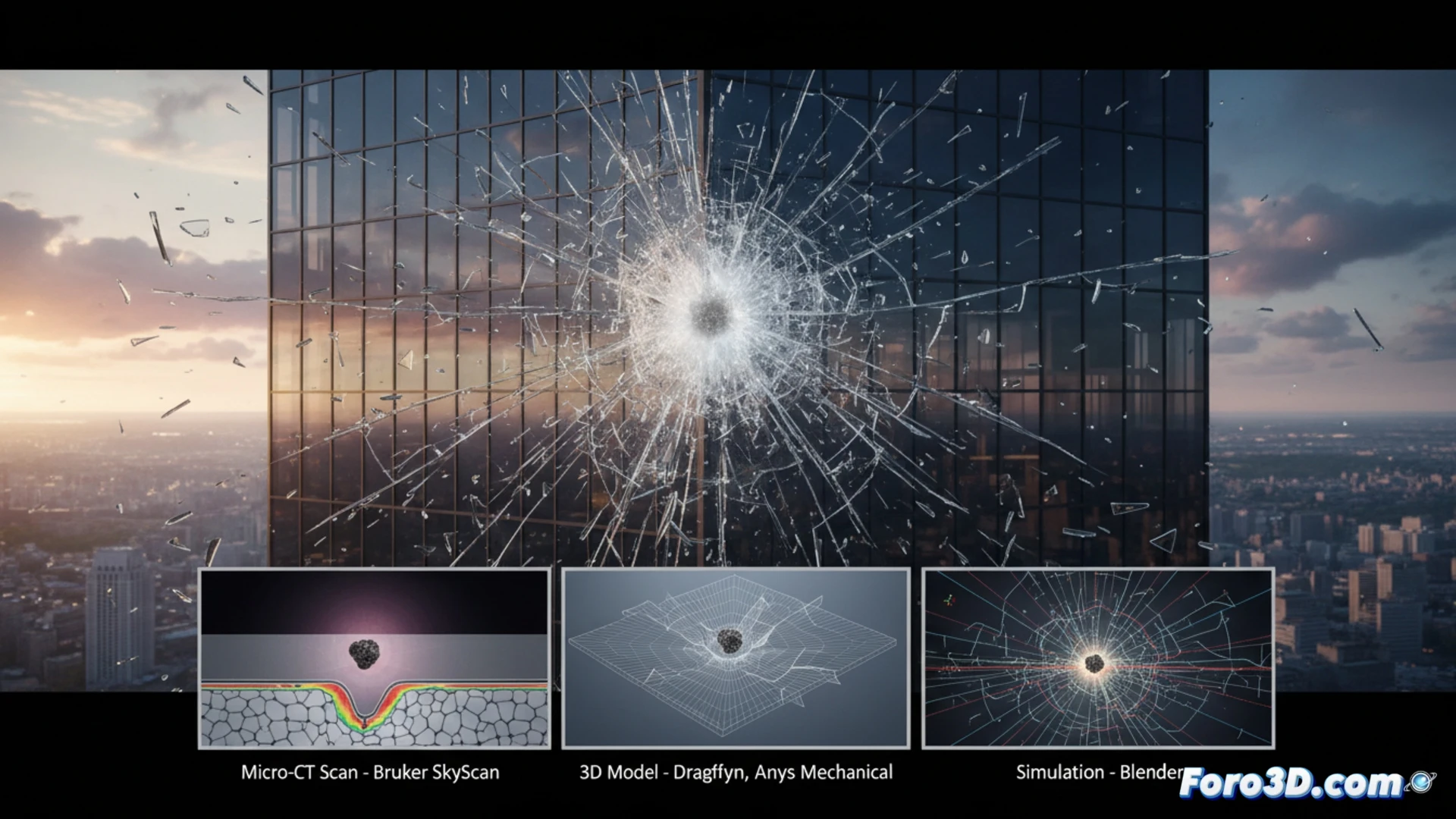
From Fragment to 3D Model: Micro-CT and Reconstruction 🧩
The process began with the meticulous collection of the glass fragments, especially those near the supposed origin of the fracture. These were scanned with a micro-computed tomography system, such as a Bruker SkyScan, capable of generating high-resolution radiographic slices. The resulting thousands of 2D images were imported into reconstruction software, like Dragonfly, to generate an accurate three-dimensional volumetric model of the fragment's interior. This 3D model allowed for the visualization and isolation of an inclusion of just a few microns, later identified as nickel sulfide, embedded in the glass matrix.
Simulation and Lessons for Materials Engineering ⚙️
With the 3D model of the inclusion, it was possible to perform stress simulations, for example in Ansys Mechanical, to understand its behavior. Nickel sulfide undergoes a phase transformation that slowly expands it at room temperature, generating enormous internal stresses in the tempered glass, whose stress equilibrium is delicate. The simulation confirmed that this tiny impurity was the starting point of the catastrophic fracture. This technical workflow not only solves forensic mysteries but also drives improvements in material quality controls and structural design protocols.
How can residual stress fatigue simulation explain and predict the spontaneous breakage of tempered glass in large-format facades?
(PS: Material fatigue is like yours after 10 hours of simulation.)