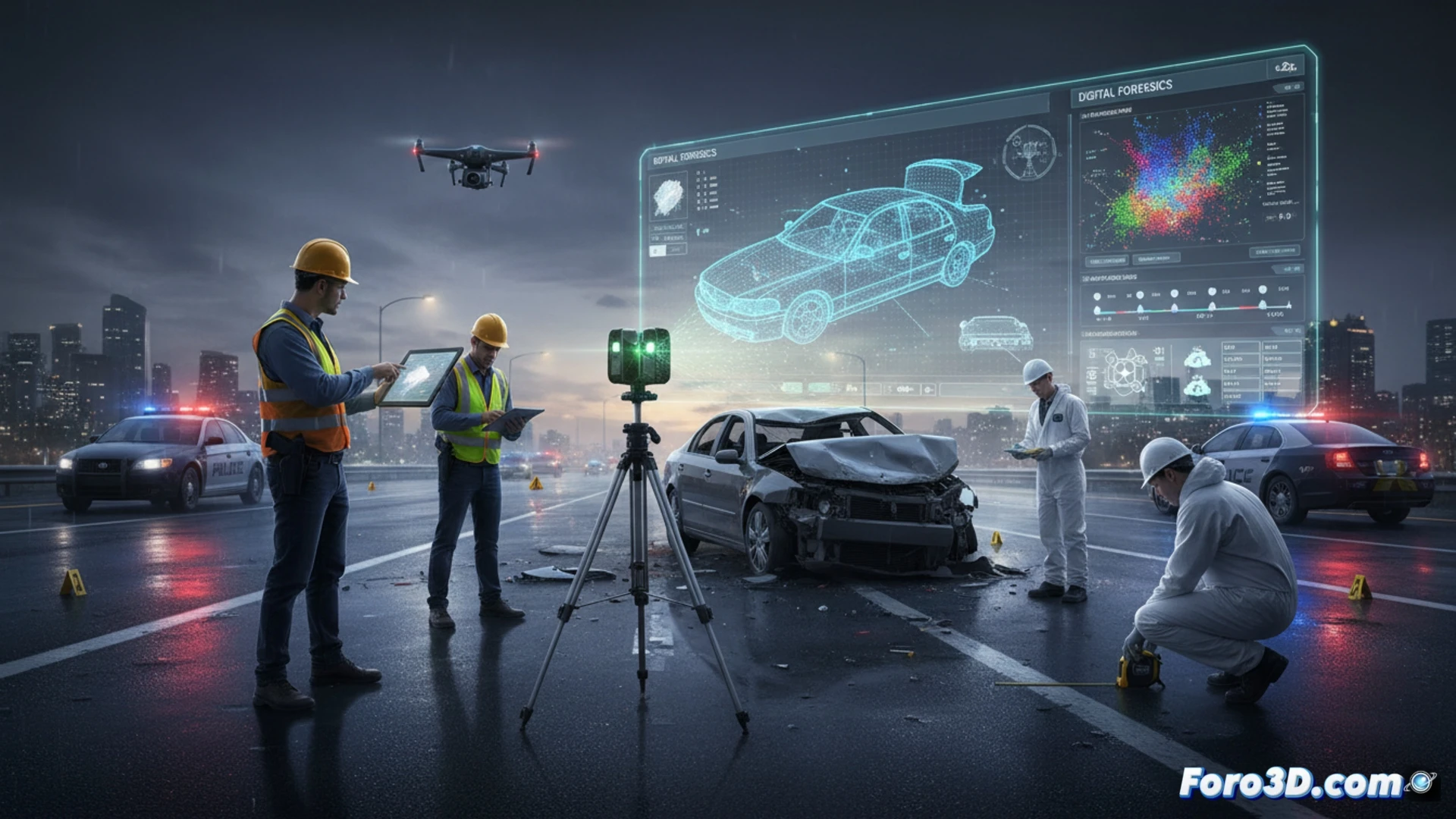
The tragic news of a child's death in an accident on the A21 reminds us of the importance of precise investigations. To determine the causes, traffic police must analyze every detail of the scene. Today, technologies like 3D laser scanning and photogrammetry allow for documenting the location with millimeter accuracy in minutes, capturing final positions, skid marks, deformations, and debris. This objective digital documentation is crucial for reconstructing what happened.
Digital Reconstruction and 3D Forensic Analysis 🔍
Once the point cloud of the scene is captured, the forensic reconstruction begins. The 3D models of the involved vehicles are integrated into the digital environment. Using game engines or specialized software, investigators can simulate dynamics, calculate trajectories, speeds, and impact angles. Event sequences are analyzed: how the motorcycle collided with the car, its trajectory towards the barrier, and the ejection of the occupants. This virtual analysis allows for testing hypotheses, determining blind spots or mechanical failures, and generating clear visualizations for expert and judicial reports.
Beyond Investigation: Prevention and Training 🛡️
The application of these technologies goes beyond the specific case. Precise 3D reconstructions help understand risk factors on specific road sections, allowing for improvements in road design and signage. Furthermore, these models are invaluable tools for investigator training and for road safety awareness campaigns, showing the consequences of accidents in a striking and rigorous manner. Thus, 3D technology becomes a key ally for justice and safety.
Would you place scale targets before scanning?