The recent presence of Queen Emeritus Sofía and the Infantas at the processions in Cartagena and Murcia, with their warm reception by the public, transcends mere social chronicle. From the perspective of political communication, this event is rich material for studying the perception of the monarchical institution. 3D technology and visual analysis emerge as key tools for scientifically deconstructing these scenes, allowing for an objective evaluation of interaction, space, and reactions, beyond subjective or media interpretation.
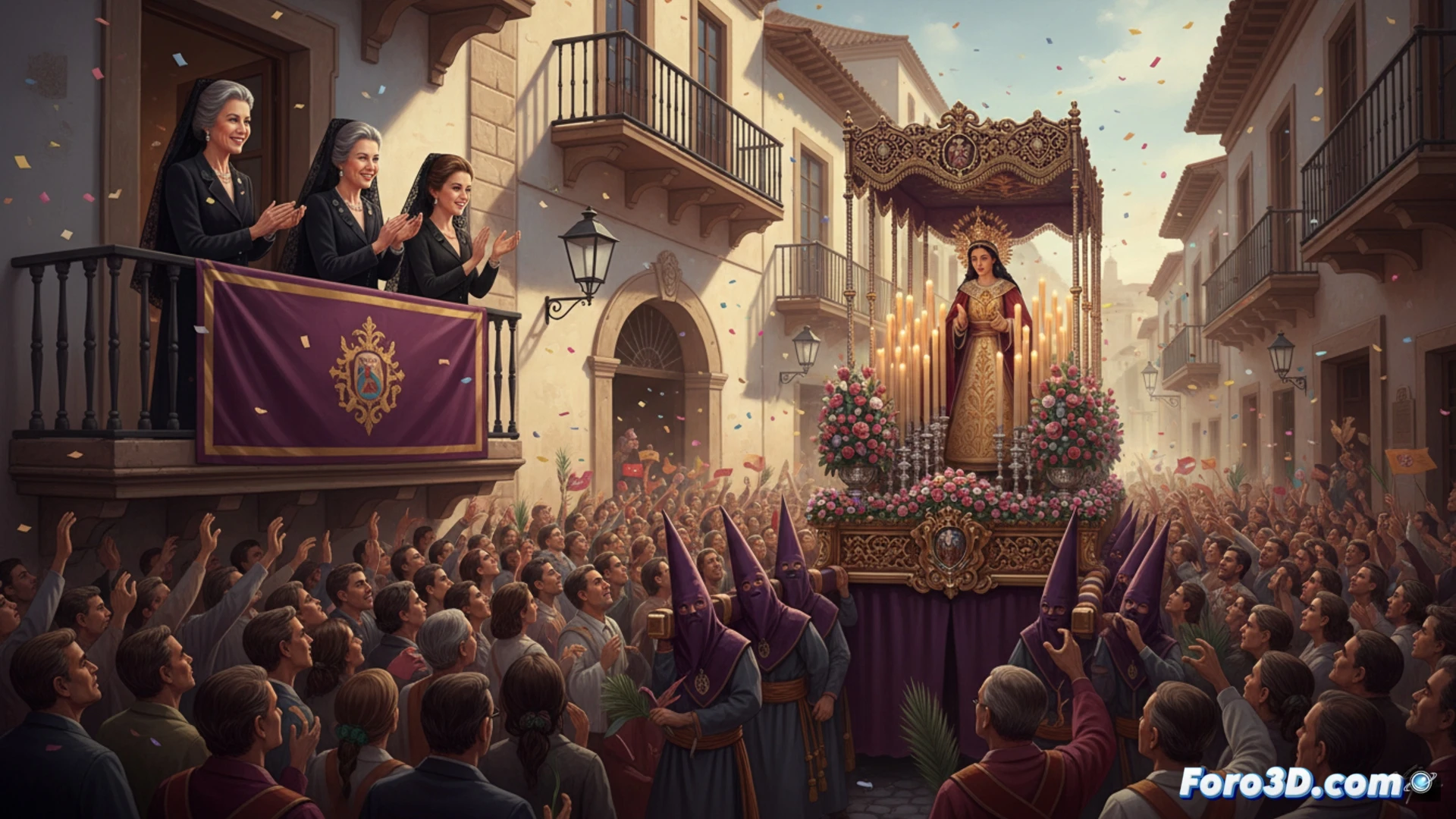
3D Modeling and Computer Vision for Objective Decoding 🔍
Imagine a geospatial 3D model of the street, populated with avatars generated from multi-camera video. This environment would allow for precise analysis of key metrics: the density and distribution of the public around the royal entourage, gaze vectors and body orientation to measure attention, and the creation of heat maps of applause synchronized with position. Facial and postural analysis tools could quantify degrees of emotion in the crowd. Furthermore, light forensic techniques, such as checking the coherence of shadows and lighting in photographs, would verify the authenticity of the event documentation, ruling out manipulations.
Simulations and the Future of Public Strategy 🧪
The true power of this technology lies in projection. A faithful model allows for simulating scenarios: how perception would vary with a different route, a different composition of the entourage, or under rainy conditions. These simulations offer a safe laboratory for optimizing non-verbal communication and planning public events, transforming intuition into data. In a hyper-visual world, mastering this technical analysis will be fundamental for building, maintaining, and analyzing narratives of authority and proximity.
How can 3D modeling and visual analysis quantify the emotional impact and public perception of a political gesture, such as the popular reception of the Royal Family during Holy Week, through the study of proxemics, facial expressions, and crowd dynamics?
(PS: analyzing political microexpressions is like looking for inverted normals: everyone sees them, no one fixes them)