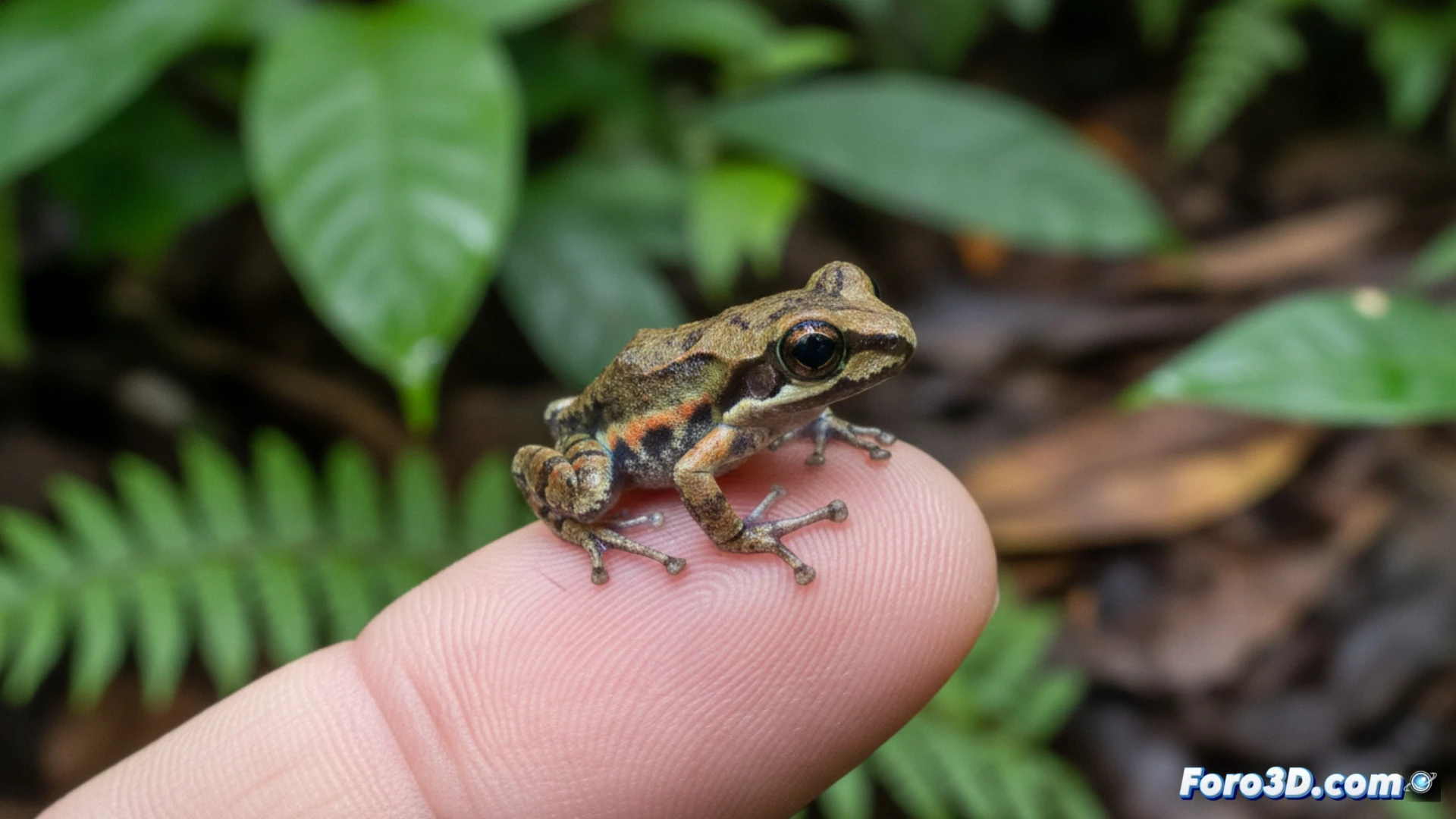
The recent description of Allobates amissibilis, a tiny frog from Guyana whose scientific name means that can be lost, presents us with a fascinating challenge for scientific visualization. With a body barely larger than a human fingernail, this species inhabits an extremely reduced territorial extension, making it a perfect case study for applying photorealistic 3D modeling techniques. The goal is to capture not only its microscopic anatomy but also the critical context of its habitat.
Photorealistic modeling and interactive microhabitat 🐸
To tackle this project, I propose a workflow that combines high-resolution photogrammetry with micro-CT scanning to reconstruct the anatomy of Allobates amissibilis at a 1:1 scale. The model must include details such as the texture of its translucent skin, camouflage markings, and the adhesive pads on its toes. The lighting phase is crucial to simulate the filtered light of the forest canopy. Subsequently, an interactive visualization of the microhabitat in the Guyana jungle will be developed, using geospatial data to recreate a plot of just a few square meters, highlighting the fragility of its territory. Including a size comparison with a coin or a grain of rice is essential to convey its actual scale.
The urgency of the small in digital outreach 🌿
This type of visualization not only satisfies scientific curiosity but also serves a crucial educational function. By modeling a creature that can literally disappear, we force the viewer to confront biodiversity loss on a tangible scale. Animated graphics illustrating the habitat reduction of Allobates amissibilis in recent years can be integrated into the same 3D scene. For documentaries and educational apps, this approach turns abstract data into an immersive experience, reminding us that the smallest things are often what are lost the fastest.
How can a creature less than a centimeter in size, like Allobates amissibilis, be modeled in 3D without losing key anatomical details for scientific visualization?
(PS: modeling manta rays is easy; the hard part is making them not look like floating plastic bags)