Al-Khwarizmi's Treatise on Algebra is not just an old book; it is the cornerstone of a discipline. Published in the 9th century, this text transformed mathematics by systematizing the solution of equations. In the niche of Scientific Visualization, we find the perfect opportunity to revive its legacy. We can transcend the flat reading of the manuscript and build interactive 3D experiences that make its abstract concepts tangible, offering a new dimension for education and historical research.
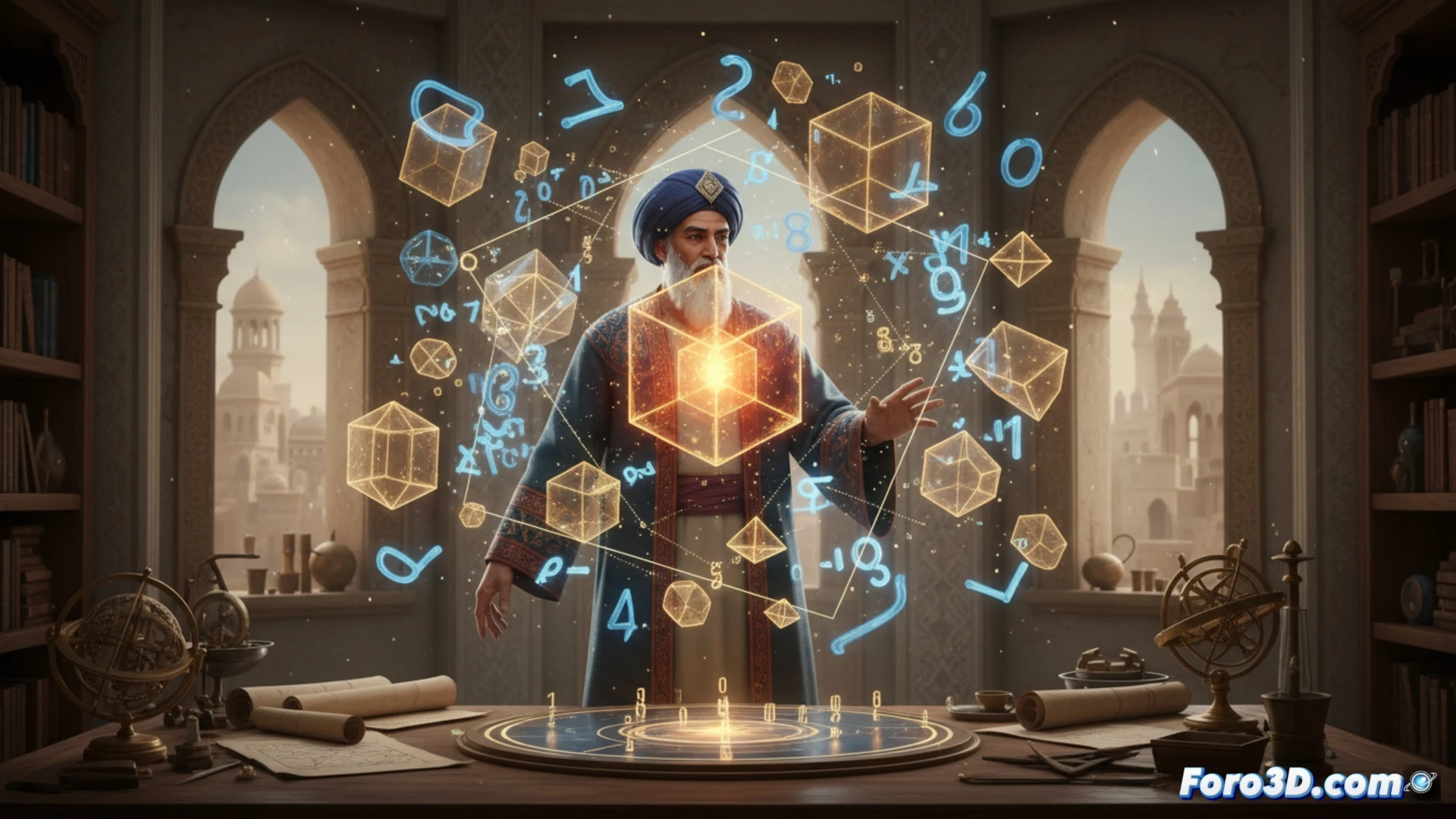
Visualization Projects: From Manuscript to Interactive Equation 🔬
Scientific visualization allows us to approach this work from multiple angles. A first project would be the digital 3D reconstruction of the original manuscript, allowing for detailed exploration without risk of deterioration. The core would be modeling its six canonical types of equations. Imagine a 3D scene where the terms thing (x) and square (x²) are represented as geometric objects that the user can visually balance, applying the rules of al-jabr (restoration) and al-muqabala (balancing) to see the solution materialize. A three-dimensional concept map could trace the routes of influence of his work towards modern mathematics.
Beyond History: A Visual Bridge for Teaching 🌉
This approach is not limited to digital archaeology. Its true power lies in creating a pedagogical bridge. An interactive model showing the evolution of algebraic notation, from Al-Khwarizmi's rhetoric to current symbolism, clarifies a complex historical abstraction. Visualizing his procedures in a 3D space turns a foundational concept into an intuitive experience, fostering a deeper and more connected understanding. It demonstrates how scientific visualization can illuminate knowledge from the past to build the future.
How can we use modern 3D visualization and augmented reality techniques to graphically represent the abstract algebraic concepts first described in Al-Khwarizmi's treatise?
(PS: modeling manta rays is easy, the hard part is making them not look like floating plastic bags)