Research presented at the Global Physics Summit proposes a mechanism to explain the matter-antimatter asymmetry. The hypothesis involves primordial black holes, tiny entities formed after the Big Bang. Their rapid evaporation via Hawking radiation would have altered the primordial plasma, creating conditions that favored an excess of matter. Thus, these ephemeral objects could be responsible for the existence of everything we see.
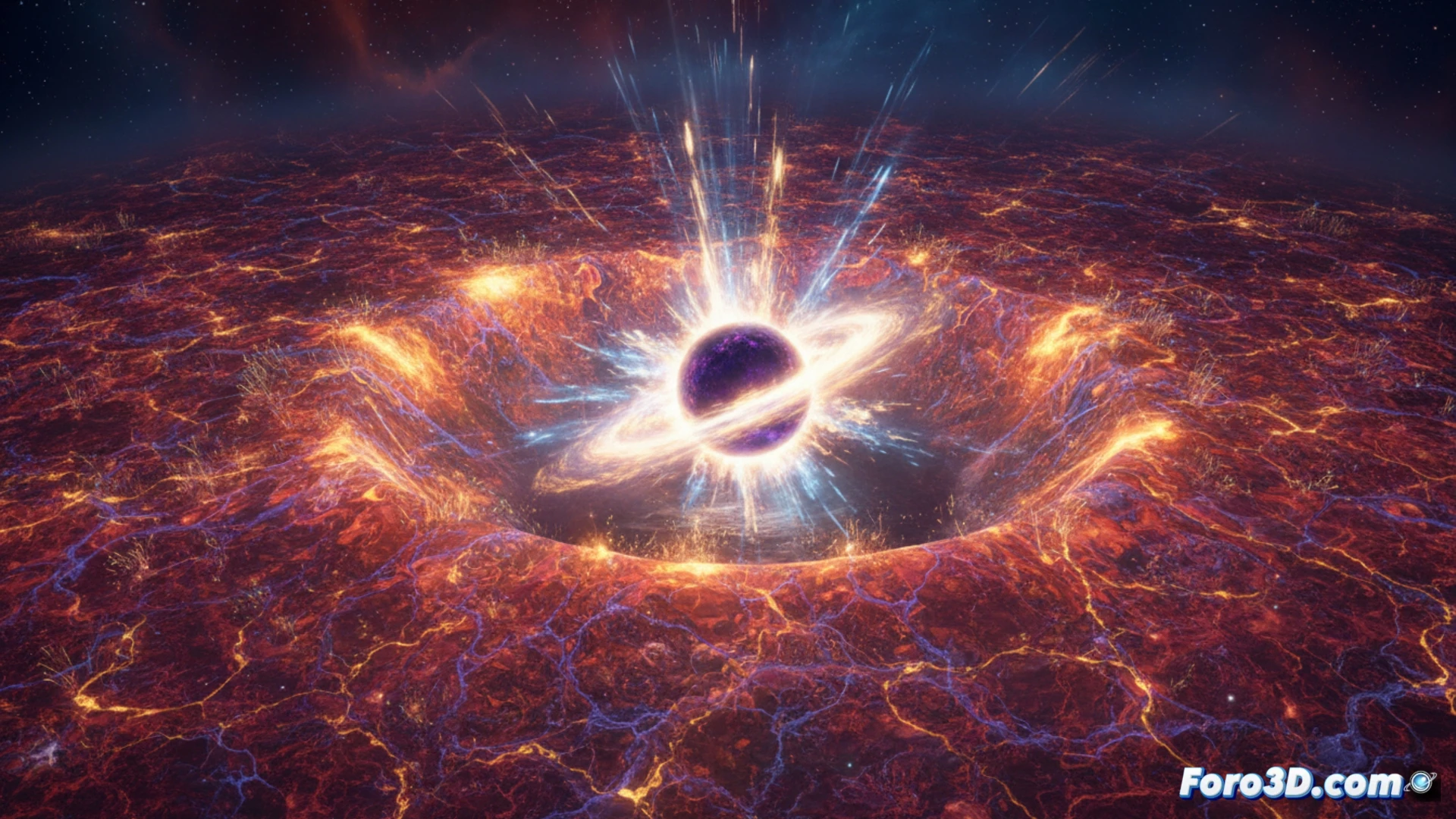
Simulations of the quark-gluon plasma and thermal perturbations 🔬
The model suggests that the explosion of a primordial black hole generated a spherical shock wave in the quark-gluon plasma. This perturbation created an abrupt gradient of temperature and density, a boundary out of thermal equilibrium. In that environment, processes like CP violation in the baryonic sector could operate more effectively, generating a small excess of quarks over antiquarks. That imbalance, replicated in numerous explosions, seeded the universe with the base matter for future structures.
Your car could be responsible for all this 🚗
It's curious to think that the key to our existence might have had the mass of a family car. Not a sports car, but rather a compact utility black hole. These entities left no trace, not even a user manual or third-party insurance. They simply appeared, made noise with their Hawking explosion, messed up the primordial plasma, and vanished, leaving the cosmic mess set up for us, eons later, to try to decipher their brief and chaotic management.