A study in Biology Letters reveals that the Agapostemon subtilior bee alters its bluish-green coloration to a coppery hue depending on environmental humidity. This reversible effect, similar to that of a mood ring, is due to the swelling of the exoskeleton layers, which modifies light reflection. For a scientific visualizer, this phenomenon is the perfect case to create an interactive 3D animation explaining the structural optics of insects.
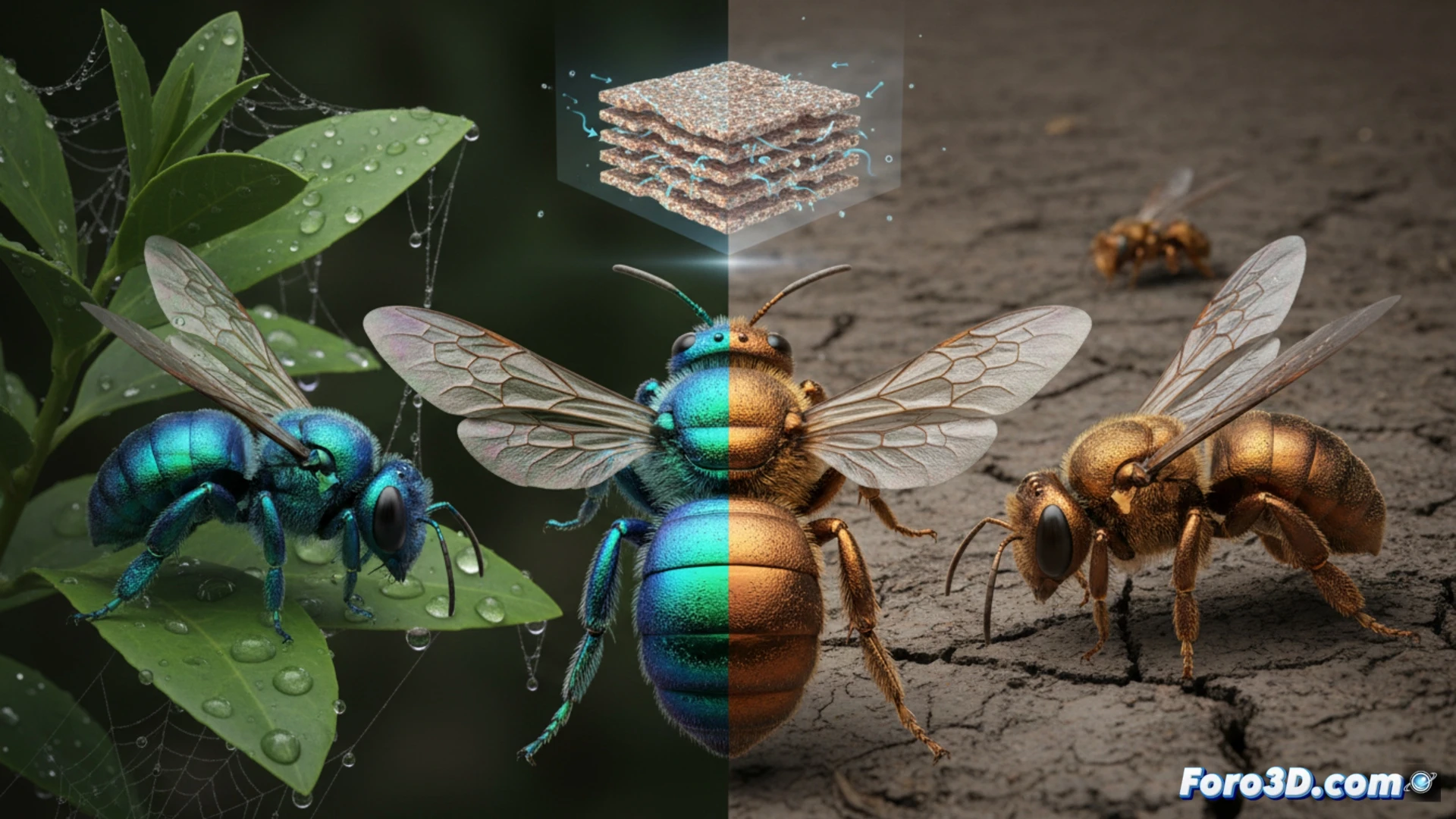
Modeling the multilayer exoskeleton and simulating swelling 🐝
The technical key lies in representing the exoskeleton as a stack of thin dielectric layers. In 3D software like Blender or Houdini, we can model a cross-section of the integument with at least three translucent layers. By activating a humidity controller (slider from 10% to 95%), a displacement modifier increases the thickness of each layer, simulating swelling. Simultaneously, a thin film interference shader must recalculate the reflected color in real time. Under dry conditions (layers close together), constructive interference favors short wavelengths (blue-green). As they swell, the distance between layers increases, shifting the reflection peak towards longer wavelengths (coppery green). The slider should control a color ramp node that interpolates between both spectral extremes, and an overlaid graph can show the wavelength peak shift (from ~480nm to ~600nm) to visually validate the optical mechanism.
Lessons for dynamic structural color visualization 💡
This project demonstrates that color in nature is not a static attribute. For the scientific visualizer, replicating this mechanism involves mastering interference shaders and simulating deformations at the microscale. The result not only educates about the biology of sweat bees but also offers a template for modeling other iridescent insects. The final lesson is clear: to capture reality, our 3D models must incorporate the environmental variable as an active parameter, not just a simple aesthetic preset.
What dynamic texture mapping techniques in real time do you recommend to simulate the chromatic change of the Agapostemon subtilior cuticle based on environmental humidity in a rendering engine like Blender or Unreal Engine?
(PS: modeling manta rays is easy, the hard part is making them not look like plastic bags floating)